
Learning from nature to improve perovskite stability
Researchers from Hong Kong University of Science and Technology (HKUST) with collaborators from Yale University, École Polytechnique Fédérale de Lausanne, and Lawrence Berkeley National Lab, have outlined a series of bio-inspired multiscale design strategies to address the stability challenges in the commercialisation of perovskite solar cells.
The research work, 'Bio-Inspired Multiscale Design for Perovskite Solar Cells', is published in Nature Reviews Clean Technology.
Perovskite solar cells have the potential to cut solar energy costs because of their low-temperature, solution-based manufacturing process. However, their commercial viability is hindered by inadequate interfacial adhesion, mechanical fragility, and susceptibility to environmental stressors (e.g., heat, moisture, and UV light).
These degradation processes occur across various length scales, from pico metres to centimetres, and multiscale structural factors can significantly affect the stability and performance of the final perovskite solar cells.
To tackle these challenges, HKUST's Zhou Yuanyuan along with his research group and collaborators in the US and Switzerland, propose that the hierarchically functional structures found in nature, such as those in leaves, can inspire the development of solar technologies that are efficient, low-cost, resilient, and adaptable to environmental changes.
Their strategy spans multiple levels:
Molecular level: Utilising bio-inspired molecular interactions for crystallisation control and degradation mitigation
Microscale level: Implementing self-healing and strength-enhancing strategies using dynamic bonds and interfacial reinforcement
Device level: Adopting functional structures inspired by nature, such as moth eyes, leaf transpiration, and beetle cuticles, to improve light management, heat dissipation, and environmental protection
“Nature provides an abundant reservoir of design solutions to help us build solar materials that can thrive in real-world conditions,” said Zhou. “We’ve already translated some of these strategies into synthetic energy devices.”
Zhou’s team proposes that future research will focus on screening bio-inspired molecules for optimal film crystallisation and stability, developing self-healing mechanisms activated by operational stress, designing cost-efficient biomicrostructures, and integrating multifunctional encapsulation to enhance the efficiency and lifespan of perovskite solar cells.
HKUST's Duan Tianwei, first author, said: “This is not just about new materials; it represents a novel approach to solar technology, inspired by nature itself. By integrating bio-inspired structures, functions, and sustainability, we are excited about the new chapter unfolding in solar energy.”
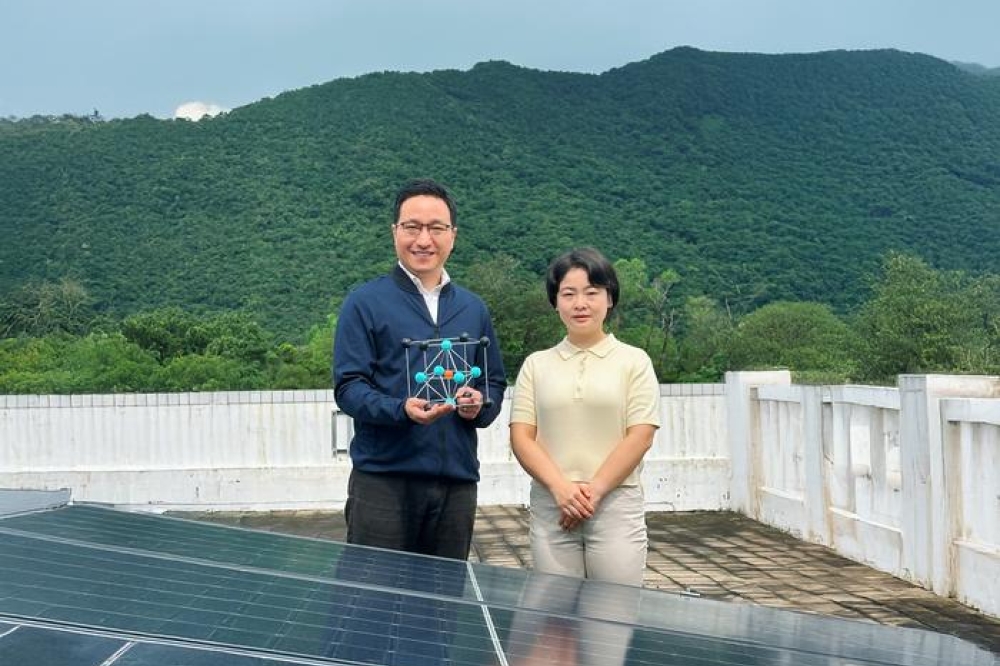
Pictured above: Zhou Yuanyuan (left), holding a crystal model of perovskite, and first author Duan Tianwei (right) standing in front of solar panels