
Novel reflection system boosts efficiency of DUV LEDs
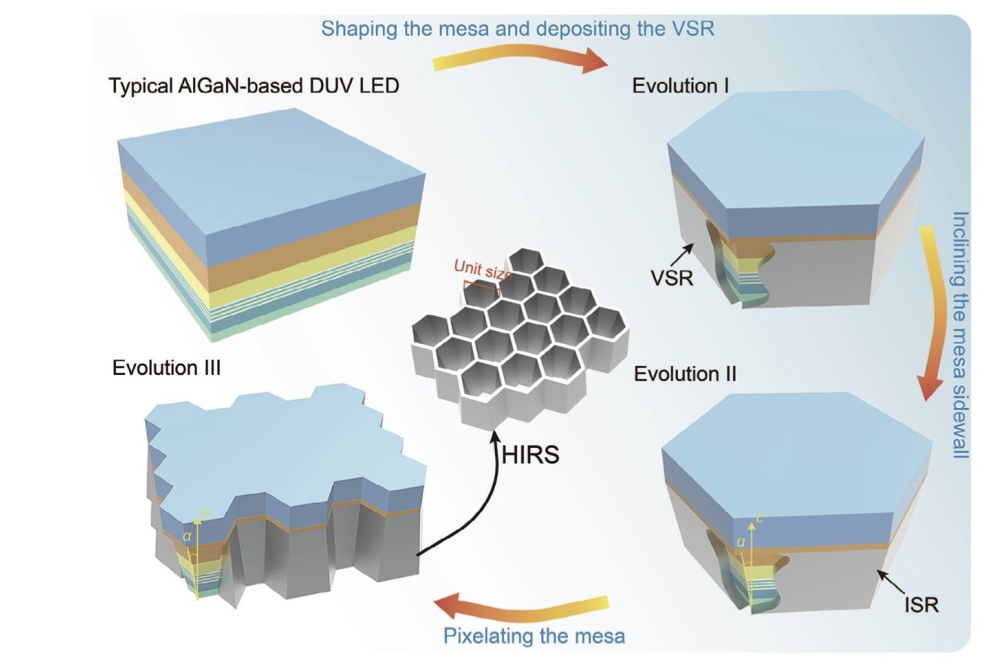
Researchers from Wuhan University and Ningbo ANN Semiconductor in China have developed a redirection-manipulated honeycomb inclined reflection system (HIRS) to significantly enhance the optoelectronic performance of AlGaN-based deep-ultraviolet light-emitting diodes (DUV LEDs).
“By integrating the HIRS into the pixelated DUV LEDs, both transverse magnetic (TM) and transverse electric (TE)-polarised light are redirected to the top of the device, overcoming total internal reflection and reabsorption losses. This strategy achieves a record light output power (LOP) enhancement factor of 1.95, the highest reported for pixelated DUV LEDs,” explained Shengjun Zhou, a professor at Wuhan University who directed the research.
AlGaN-based DUV LEDs are critical for mercury-free UV light sources in sterilisation, sensing, and water purification. However, their efficiency is limited by the dominant TM-polarised light emission in high-Al-content AlGaN multiple quantum wells, which propagates laterally and suffers severe reabsorption losses due to the internal reflection effect. Conventional methods, such as pixelating DUV LED chips, inevitably reduce the area of active region and p-type contact, which in turn reduces emission power and substantially increases the operating voltage.
The team’s HIRS design, described in the paper ‘Redirection-Manipulated Honeycomb Inclined Reflection System Enables Highly Efficient AlGaN-Based Deep-Ultraviolet Light-Emitting Diodes’ combines hexagonal sub-mesa arrays with sidewall reflectors inclined at an optimal angle of 46°.
Finite-difference time-domain (FDTD) simulations revealed that this configuration shortens the lateral propagation path of photons, redirecting trapped photons upward and reducing reabsorption. This advancement addresses critical challenges of balance between light extraction efficiency and electrical performance, marking a significant step toward commercial high-power DUV source solutions.
The team further validated practical applications through a miniaturised sterilisation module using HIRS-integrated DUV LEDs, achieving 99.99% E. coli inactivation at 1 L/min water flow rates. This work not only advances high-power DUV LED design but also demonstrates practical solutions for efficient water purification.
Reference
Zhefu Liao et al; Laser & Photonics Reviews 2025, 19(10), 2401698