
Scientists design multi-robot lab to discover new quantum dots
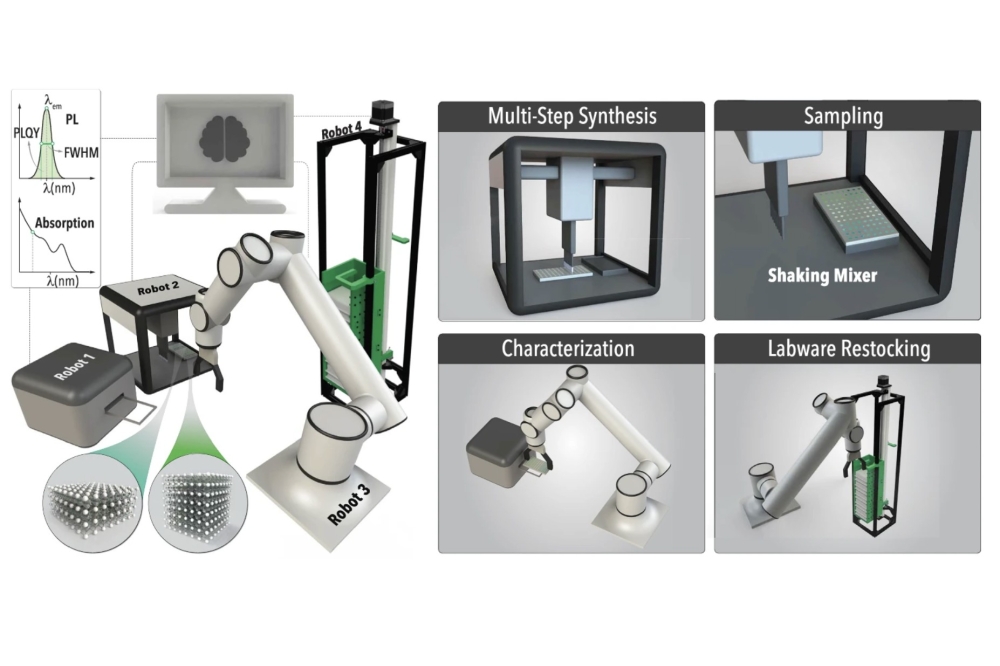
Researchers at North Carolina State University have developed a multi-robot self-driving laboratory that autonomously discovers high-performance quantum dots for next-generation displays, solar cells, LEDs and quantum-engineering technologies.
Their paper describing the work, 'Autonomous multi-robot synthesis and optimisation of metal halide perovskite nanocrystals', is published in the journal Nature Communications.
Combining robotics with artificial intelligence, 'Rainbow' (which combines a characterisation robot, a pipetting robot, a robotic arm, a labware refreshment robot, and an AI agent) can conduct and analyse up to 1,000 experiments per day without human intervention, accelerating the pace of materials discovery.
“Rainbow brings together multiple robots working in concert to autonomously explore and optimise complex chemistries with extraordinary efficiency,” says Milad Abolhasani, corresponding author of the paper and ALCOA professor of Chemical and Biomolecular Engineering at NC State. “Rainbow’s robots automatically prepare chemical precursors, mix them, and execute multiple reactions in parallel using miniaturised batch reactors – up to 96 reactions at a time. The system then automatically transfers all reaction products to a characterisation robot, which analyzes the outcomes. From start to finish, every step is fully automated and intelligently coordinated.”
To use Rainbow, users begin by designating a target material property – such as emission wavelength or bandgap. Users also give Rainbow an experimental “budget,” providing it with how many experiments it should conduct before stopping. From there, Rainbow designs, executes and analyses each experiment, using real-time optical characterisation and machine learning to decide what to try next in its search for the ideal nanocrystal. In other words, it will autonomously determine which quantum dot synthesis recipe will most efficiently convert an energy input into the desired energy output.
“Rainbow doesn’t sleep; it works around the clock, performing in days what would take human researchers years,” Abolhasani says. “But it’s not designed to replace scientists; it’s built to empower them by handling the tedious, time-intensive parts of discovery so they can focus on design and innovation.”
Abolhasani is a leader in self-driving lab technologies, but the robotic elements of Rainbow make it a significant departure from his previous work. By using robots to conduct experiments in different reactors, Rainbow allows researchers to conduct experiments using a wider range of precursor chemistries.
“Because we are not confined to a fixed set of precursors, there is a wider range of potential outcomes in terms of what the highest quality quantum dot will be made of,” Abolhasani says. “In addition, Rainbow allows us to explore various ligand structures on the surface of these nanocrystals, which can play a key role in controlling the properties of these quantum dots.
“With Rainbow, we’ve built a system that not only finds the best quantum dots faster than ever before, it also tells us why they work,” said Abolhasani. “That’s the power of combining robotics, AI and chemistry in a single, intelligent lab platform.”
Once Rainbow has identified the best recipe for producing a desirable quantum dot, the system can then be converted from operating small-scale batch reactors for research purposes to operating large-scale reactors for manufacturing.