
UVC LEDs for disinfection on the way to widespread use
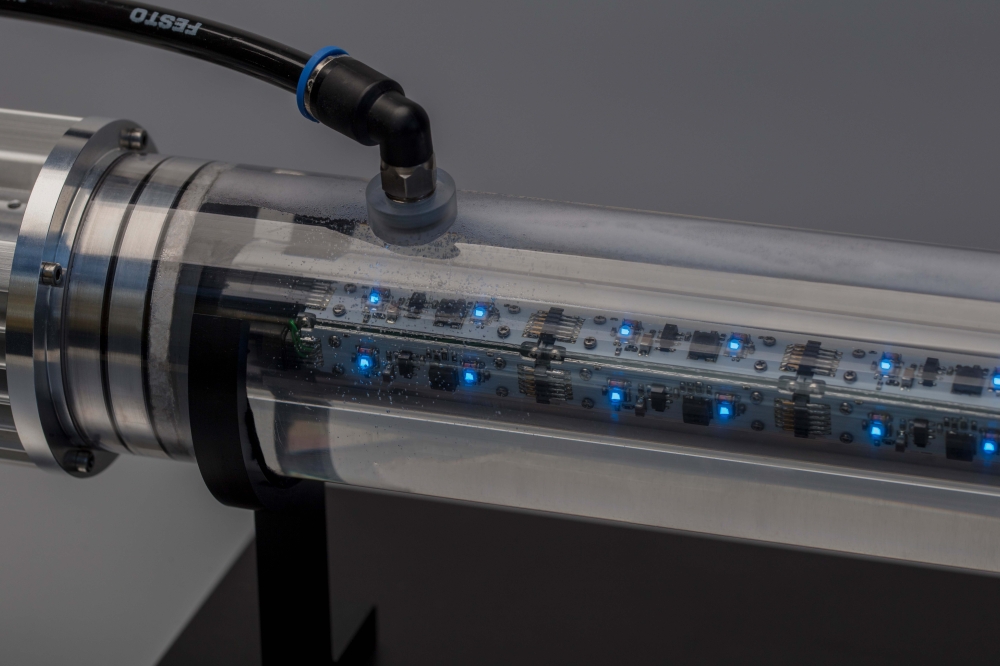
An international team of researchers has, for the first time, comprehensively assessed the state of the art of commercial UVC LEDs and summarised the findings in an open-access review.
Researchers from the Ferdinand-Braun-Institut (FBH) in Berlin, together with four other institutions, investigated UVC LEDs from 14 manufacturers over a period of two years, covering devices with wavelengths between 260 and 280nm.
UV light can inactivate pathogens on surfaces, in the air, and in water. LEDs operating in the UVC spectral range at wavelengths below 280nm are gaining importance thanks to rapid advances in efficiency and lifetime. In contrast to conventional UV lamps, they are extremely compact, dimmable, capable of fast switching, and, most importantly, free of mercury.
“Our data support both manufacturers and end-users in making well-informed decisions for the development and deployment of UVC LED systems,” explains Jan Ruschel, a researcher at FBH and one of the lead authors of the review in the Journal of Physics: Photonics, Volume 7, Number 3.
The paper 'Efficiency- and lifetime-limiting effects of commercially available UVC LEDs: a review' provides an overview of the performance and particular characteristics of the technology, offering solid data to help to open up both existing and new UVC applications with LEDs.
Applications from water purification to air cleaning
UVC LEDs open up a wide range of everyday applications: from environmentally friendly drinking water treatment (pictured above is a demonstrator of a UVC LED module for water disinfection) and air purification in schools and hospitals to the disinfection of refrigerators, dishwashers, touchscreens, and production facilities in the food industry.
In regions without stable power supply, their compact design and low energy requirements enable mobile, solar-powered solutions. Unlike the low-pressure UV lamps that are still commonly used today, UVC LEDs do not contain toxic mercury, show relatively low sensitivity of emission properties to temperature changes, and often have longer lifetimes already.
A guide for manufacturers and users
The now published paper surveys key parameters of UVC LEDs available on the market that are critical for developing disinfection systems. Both lifetime and efficiency vary significantly – depending on operating conditions, design, and manufacturer. The researchers address thermal, optical, and electrical effects, and how these can be influenced through material selection and operating parameters.
Among other factors, the package type plays an important role. A particular focus is placed on lifetime studies in the form of long-term stress tests under various conditions.
Users who want to integrate UVC LEDs into their systems can use this information to derive how cooling, power control, optics, and LED monitoring should be designed. “With this, we have successfully closed the gap between laboratory research and practical application,” says Ruschel. “As an application-oriented research institute, it is of special importance to us that innovations truly find their way into real-world use.”
The team included Ferdinand-Braun-Institut (FBH), Germany; Signify, Eindhoven, The Netherlands; University of Padua, Padua, Italy; RTI International, Durham, NC, USA; and Delft University of Technology, Delft, The Netherlands.