
A way forward for pure-blue perovskite LEDs
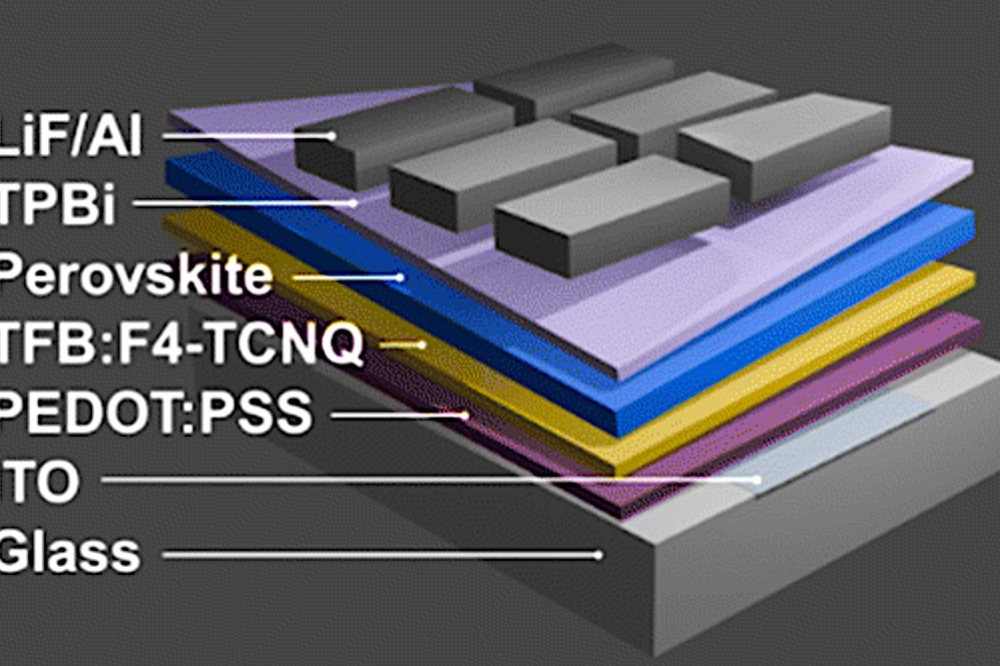
Korean researchers have reported an in-situ passivation strategy for pure-blue perovskite LEDs (PeLEDs), opening up the possibility of making next-generation displays using vacuum thermal evaporation. Their work is published in the journal Industrial Chemistry & Materials on August 25.
Metal halide perovskites are rapidly emerging as candidates for the next generation of displays thanks to their narrow emission linewidths, tuneable bandgaps, high photoluminescence quantum yields, and compatibility with scalable manufacturing.
Unlike many solution-processed emitters, perovskites can be vacuum-thermally evaporated on the same toolsets used for OLED production, enabling precise thickness control, fine patterning, uniform films, and fully dry processing—key requirements for industrial adoption.
Within this landscape, pure-blue emission is particularly prized for wide-gamut, high-definition displays. The Rec.2020 blue point lies near 468vnm in the CIE 1931 space, placing the 460–475 nm window in an optimal range for vivid colour without the eye fatigue often associated with deeper blue (<460 nm) or the washed-out appearance of sky blue (>475 nm).
Yet this region is challenging: higher Cl/Br ratios can trigger phase segregation and spectral drift, and the human eye’s lower sensitivity here tends to depress apparent brightness. In vacuum-processed perovskites, unsaturated Pb(II) defects formed under halide-deficient conditions further act as non-radiative centres that erode efficiency.
The team has addressed these bottlenecks with an in-situ passivation approach during vacuum thermal evaporation. A phenanthroline-based small molecule, BUPH1 (4,7-di(9H-carbazol-9-yl)-1,10-phenanthroline), is co-evaporated with the perovskite precursors so that, as the film grows, BUPH1’s nitrogen lone pairs coordinate Pb(II) and passivate halide-vacancy defects, helping to suppress ion migration without extra processing steps.
In parallel, the halide composition is precisely tuned by co-evaporating PbBr2, CsCl, and CsBr to target the pure-blue window.
“As perovskites compatible with vacuum thermal evaporation are compelling for next-generation displays, low efficiency has remained a persistent bottleneck,” said Byungha Shin, corresponding author and professor at the Korea Advanced Institute of Science and Technology (KAIST). “By passivating under-coordinated Pb(II) during growth, we identify a practical path toward overcoming that hurdle—achieving colour-stable pure-blue emission while staying aligned with industry-standard fabrication.”
As a result, the devices emit at 472 nm with a 19 nm FWHM and reach an EQE of 3.1 percent, among the highest reported for thermally evaporated pure-blue PeLEDs to date.
Importantly, the emission remains colour-stable under electrical bias, supporting Rec.2020, the ITU-R wide-gamut UHDTV standard. Because the strategy is compatible with mainstream OLED-class vacuum tools, it offers a practical route toward industrially relevant, high-colour-purity blue pixels, according to the team.
Looking ahead, the team will pursue additional passivation strategies to further raise luminance and extend operational lifetime, with the goal of fully thermally evaporated device stacks suited for manufacturing.
This research was supported by the National Research Foundation of Korea (NRF) grant funded by the Korea government (MSIT).