
Hexagonal BN detects 14.1MeV fusion neutrons
Nuclear fusion power offers the prospect of an almost inexhaustible source of energy in the future, but it also presents many unresolved engineering challenges.
The most feasible reaction is between the nuclei of two heavy isotopes of hydrogen – deuterium (D) and tritium (T). This needs robust and efficient 14.1 MeV neutron detectors for monitoring and controlling the process, evaluating and mitigating the impact of neutron radiation on materials, and ensuring the efficient breeding of tritium fuel.
Now a research team at Texas Tech University has achieved a breakthrough in applying ultrawide wide bandgap (UWBG) semiconductors to fusion technology by successfully creating the first semiconductor detector for 14.1 MeV D-T fusion neutrons with a practical 5 percent detection efficiency.
The stacked detector was fabricated by graduate student Gokul Somasundaram using 1 mm thick, 4 inch-diameter h-BN quasi-bulk crystals that were grown by graduate student Zaid Alemoush using HVPE. The work was supported by ARPA-E’s 2021 OPEN program.
Detecting fast neutrons using compact semiconductor detectors is exceptionally difficult due to the low interaction cross-section of fast neutrons with matter. Today, suitable semiconductor-based detectors with practical detection efficiency don't exist.
The TTU team has achieved their record detection efficiency of 5 percent for 14.1 MeV fast neutrons by engineering an effective neutron interaction path length of 1 cm.
The interaction cross-section of 14.1 MeV fast neutrons with matter is exceptionally small (in the order of 1 barn), leading to large mean free paths in all semiconductors.
In h-BN, the mean free path measured by the team was 11.3 cm, meaning that achieving an intrinsic detection efficiency of greater than 63 percent for 14.1 MeV neutrons would require an h-BN detector with a thickness larger than 11.3 cm, which is a formidable (perhaps impossible) task.
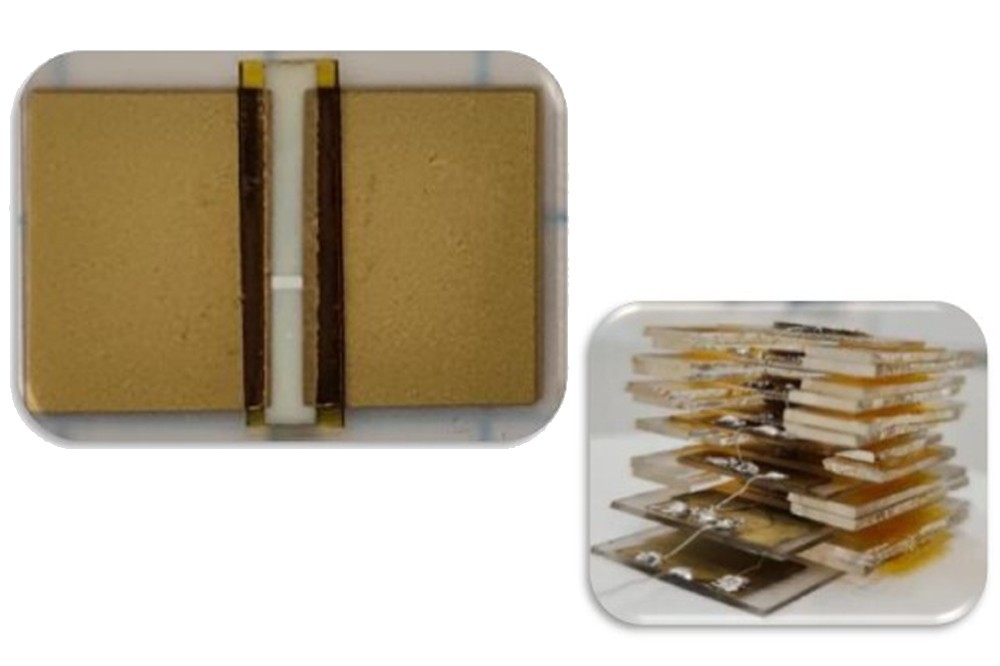
The TTU team produced 1mm thick, 4 inch-diameter freestanding h-BN quasi-bulk wafers by HVPE, which offers high growth rates. A stacked detector in a lateral geometry was then fabricated from h-BN quasi-bulk crystals, having a total thickness of 5 mm and length of 1 cm.
The detector delivered a neutron detection efficiency of 5.0 percent and a charge collection efficiency of 59 percent when the 14.1 MeV neutron beam was aligned parallel to the c-plane of h-BN.
In addition, the detector exhibited a substantial neutron-generated direct current, suggesting the feasibility for realising portable and battery-powered D-T fusion neutron sensors.
This achievement builds on the team’s previous realisation of h-BN thermal neutron detectors with record high detection efficiency of 60 percent (see, AIP News and Appl. Phys. Lett. 116, 142102 (2020) doi: 10.1063/1.5143808 and J. Appl. Phys. 135, 175704 (2024) doi: 10.1063/5.0179610).
According to the team, their work shows the feasibility of making highly sensitive, compact, radiation-hard and battery-powered D-T fusion neutron sensors, with benefits for diverse applications including advanced nuclear reactor design and managing nuclear waste.
Moreover, they say that the availability of h-BN semiconductor detectors with capability of simultaneously detecting thermal and fast neutrons with high efficiencies could open unprecedented applications which are not possible to attain by any other types of neutron detectors.
Building on these achievements, the scientists plan to produce h-BN quasi-bulk crystals with improved crystalline quality and optimise the detector geometry to further increase detection efficiency and sensitivity. They are also seeking partners with capabilities of system integration to thoroughly characterise such detector systems in D-T fusion environments.
Pictured (L): Top view of the lateral detector fabricated from the same 1 mm-thick freestanding h-BN wafer. The device features an electrode spacing of 1.3 mm, a length of 1 cm, and a reduced thickness of 0.7 mm after mechanical polishing.
Pictured (R): Side-view optical image of the seven-layer stacked h-BN fast neutron detector. The detector has a total thickness of 5 mm and device dimensions of 1.3 mm (W) × 10 mm (L).
Reference
G. Somasundaram, Z. Alemoush, J. Li, J. Y. Lin, and H. X. Jiang; Appl. Phys. Lett. 127, 162103 (2025)