
Molecular tweak boosts deep-blue OLED efficiency
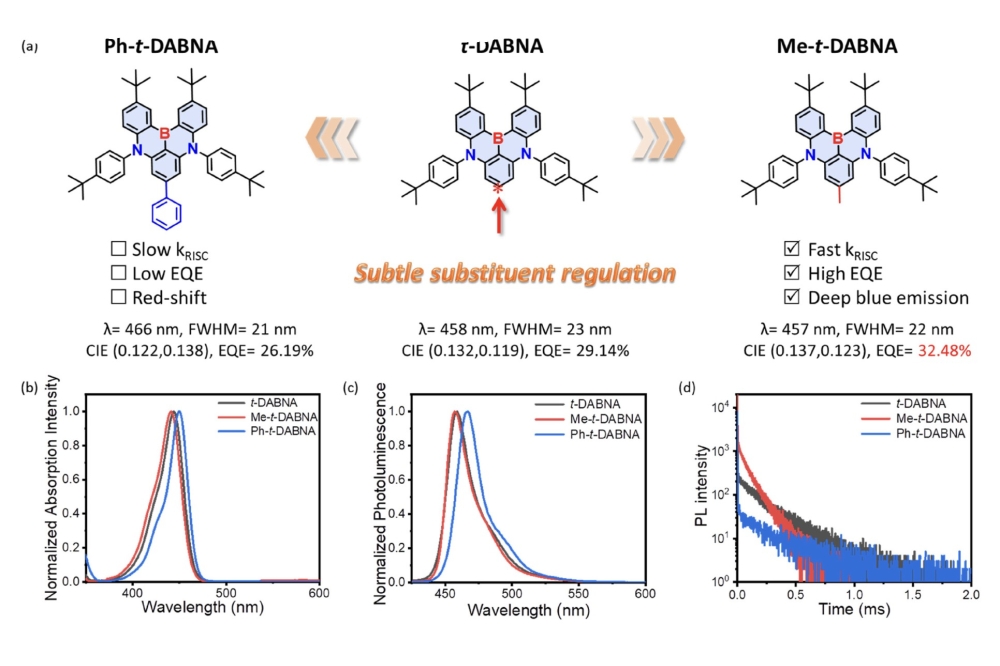
Chinese researchers achieve brighter, more efficient, and colour-accurate OLED displays through a simple chemical modification.
Researchers from the South China University of Technology, Jihua Laboratory, and Jilin University have developed a new way to make deep-blue OLED devices more efficient without compromising on colour quality.
Their study, 'Enhancing Device Efficiency Through Subtle Substituent Tuning in DABNA-Based Emitters' published in FlexTech, introduces a simple yet powerful molecular adjustment that could help shape the future of high-end display technologies.
The teams led by Peng Junbiao and Wang Jiaxuan focused on a well-known OLED material called t-DABNA, used in multi-resonance thermally activated delayed fluorescence (MR-TADF) emitters. These materials are key to achieving rich, pure colours in energy-efficient OLED screens.
In their latest work, the researchers replaced a single chemical group in the molecule, swapping a phenyl for a tiny methyl group. This seemingly small change made a big difference.
According to the team, it maintained perfect colour purity: Deep-blue emission at 457 nm, with an exceptionally narrow spectrum (22 nm). In addition, the reverse intersystem crossing rate (known as kRISC) increased threefold, improving light output. Finally, the the material’s delayed fluorescence time was shortened by more than half, helping maintain brightness at high power.
The result was a next-generation OLED device that reached a world-leading 32.48 percent external quantum efficiency (EQE), vivid deep-blue colour close to the BT.2020 display standard, and an ultrahigh brightness of 11,619 cd/m² all while keeping energy loss low.
OLEDs are already used in smartphones, TVs, and wearable devices, prized for their rich colours, thinness, and flexibility. However, creating a true, energy-efficient deep-blue light has been one of the biggest challenges in display engineering. Blue light requires high energy and precise control; any instability can quickly lead to poor efficiency or colour fading.
Traditional materials could boost brightness, but usually at the cost of colour purity, say the team. The new 'methyl substitution' approach solves that trade-off, allowing both qualities to coexist.
“Even a small chemical change can lead to major performance gains,” says Wang Jiaxuan of Jihua Laboratory. “Our work provides a practical blueprint for designing next-generation OLED materials.”
The team used advanced computer modelling (TD-DFT calculations) to understand why the methyl group improved performance. They found that it narrowed the energy gap between molecular states, promoting efficient energy transfer and light emission while not affecting the blue colour.
In contrast, replacing methyl with a bulkier phenyl caused unwanted colour shifts and slower energy conversion, proving that precision is key in molecular design.
Reference
Hou, Lili, Jiaxuan Wang, Yufang Nie, et al; FlexTech (2025)