
NTT develops AlN-based mmWave transistor
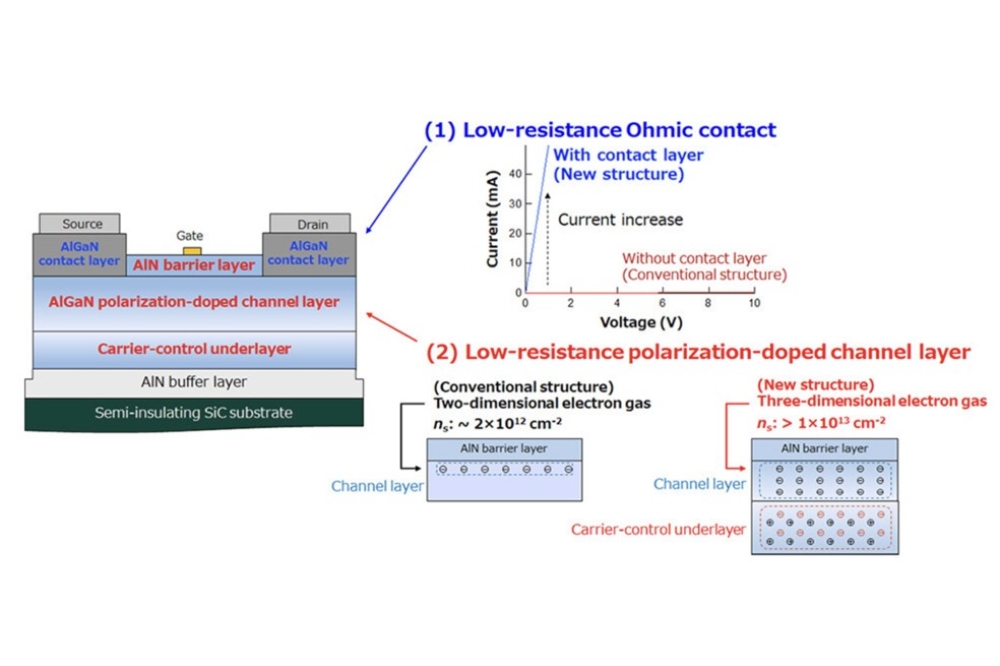
NTT has achieved, for the first time, amplification of mmWave signals used in wireless communications in AlN-based transistors by designing a low-resistance structure.
The results will be presented at the international conference 71st IEEE International Electron Devices Meeting (IEDM 2025) in San Francisco on December 10, 2025.
NTT has developed two technologies for solving the issues of high contact resistance and high channel resistance that have so far hindered high-frequency signal amplification in AlN-based transistors. These approaches include a contact layer that reduces the energy barrier at the electrode-semiconductor interface and a channel structure that generates a high electron concentration.
Low-resistance ohmic contact using an AlGaN contact layer
In conventional structures where electrodes are formed directly on the AlGaN channel layer, increasing the Al composition raises the energy barrier between the electrode and semiconductor, making it difficult to obtain ohmic contact and limiting the drain current. To reduce this energy barrier, NTT developed a technique to form an AlGaN contact layer with graded Al composition between the electrode and channel layer. This enables the reduction in the Ohmic contact resistance.
Low-resistance channel via a polarisation-doped structure
In conventional AlGaN channel structures with uniform Al composition, the 2D electron gas formed at the interface between the AlN barrier layer and AlGaN channel layer is used as the current path. However, in high-Al-content AlGaN, the reduction in two-dimensional electron-gas density leads to increased channel resistance and limited drain current. The energy barrier for confining the electron gas within the channel is also low, making it difficult to achieve a high on/off current ratio.
NTT developed a polarisation-doped channel structure in which an AlGaN channel layer with graded Al composition is sandwiched between an AlN barrier layer and charge-control underlayer, enabling the formation of a high-density three-dimensional electron gas within the channel layer. This significantly reduces the channel resistance.
Research Results
Using these technologies, NTT fabricated AlN-based transistors in the high-Al-composition range (Al compositions of 78, 85, and 89 percent). Even in the Al-composition region above 75 percent, where drain current had previously been severely limited, NTT confirmed large drain current and excellent current linearity in the linear region of the transistor.
As one example, the transistor with 85 percent Al composition exhibited a high drain current exceeding 500 mA/mm and high on/off ratio exceeding 109. With these improvements in transistor performance, NTT succeeded in achieving RF-power amplification above 1 GHz in AlN-based transistors with Al composition exceeding 75 percent.
The transistor with 85 percent Al composition also achieved a maximum frequency of oscillation (fmax) of 79 GHz in the mmWave band (30-300 GHz)—the highest among AlN-based transistors reported to date. Since higher Al composition is advantageous for achieving higher output power in high-frequency transistors, the structure proposed in this study provides a design guideline for achieving the intrinsic potential of AlN, representing an important advancement toward the application of AlN-based high-power, high-frequency transistors.
Going forwards, NTT plans to design device structures capable of higher current and voltage operation to demonstrate high-power operation of these high-frequency transistors and continue research and development toward the practical implementation of AlN-semiconductor technology from power conversion to wireless communications.