Researchers use dim light to produce bright LEDs
Researchers at Princeton and North Carolina State University have developed a technique that substantially improves the ability to convert low-energy light into a high-energy version. The method has immediate applications in lighting and displays.
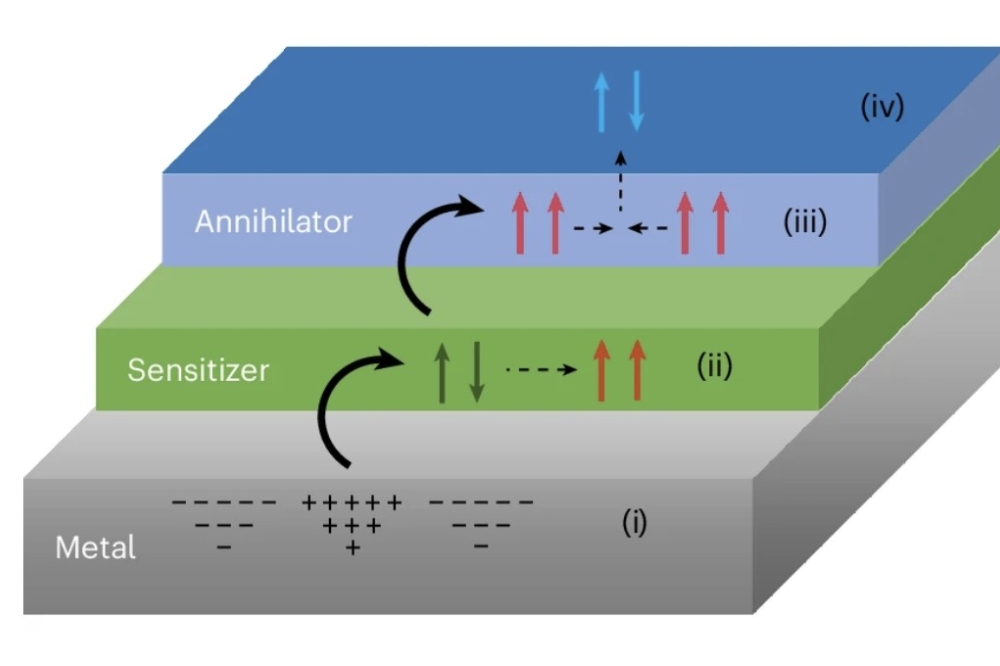
The research builds on a technique called triplet-fusion upconversion, which uses a combination of molecules to gather lower-energy light, such as green light, and convert it to a higher-energy version like blue or ultraviolet light.
The molecules absorb energy from the incoming light and temporarily store it by shifting electrons into a higher orbital state. The excited molecules collide and release the stored energy as higher-energy versions of light.
Upconversion is known to work well in liquids, because the molecules move constantly, allowing them to interact and boost the light’s energy. In solids, excitations can’t move very easily.
Researchers led by Barry Rand, a Princeton professor of electrical and computer engineering, proposed harnessing the free electrons on the surface of metals in order to boost upconversion on a thin metal film.
When light hits these free electrons, it sets off an oscillation that merges the light’s energy with the electrons’ movement. These oscillations (known as plasmons) concentrate light and enhance the electromagnetic field.
In an article 'Plasmon-enhanced ultralow-threshold solid-state triplet fusion upconversion' published in the journal Nature Photonics, the research team described how they used a silver film to generate surface plasmons by exposing the film to low-energy light.
As the plasmons propagated across the silver film, they increased the absorption of light by the upconversion molecules by about ten times compared to previous setups. The researchers said that the increased absorption allowed the system to increase the concentration of molecules that had absorbed the light, drastically cutting the intensity of light needed to trigger upconversion.
The experimental results showed that the technique reduced the power needed to drive the reaction by 19 times compared to a non-plasmonic system.
The researchers demonstrated an immediate practical application for the technology by building an organic light-emitting diode (OLED), to test the method and demonstrate viability. The researchers used the plasmonic film to generate blue light, and they combined the blue light with green and red light from an existing OLED to generate white light.
Blue OLEDs can be challenging to operate because generating blue light requires high energy and can lead to instability. With their demonstration, the researchers showed that the thin-film technology can serve as a blue-light source without the need for high-energy input or special materials.
The paper notes that future work could include improvements in white OLEDs through the development of higher performing films and optical structures.
Pictured above: Schematic of plasmon-enhanced upconversion: (i) excitation of plasmons, (ii) absorption of plasmons by sensitizer molecules, followed by intersystem crossing and transfer of excited triplets to the annihilator, (iii) triplet–triplet annihilation to form a singlet and (iv) radiative recombination of the singlet exciton to emit higher-energy light.