
Phlux sensors attract interest from shooting community
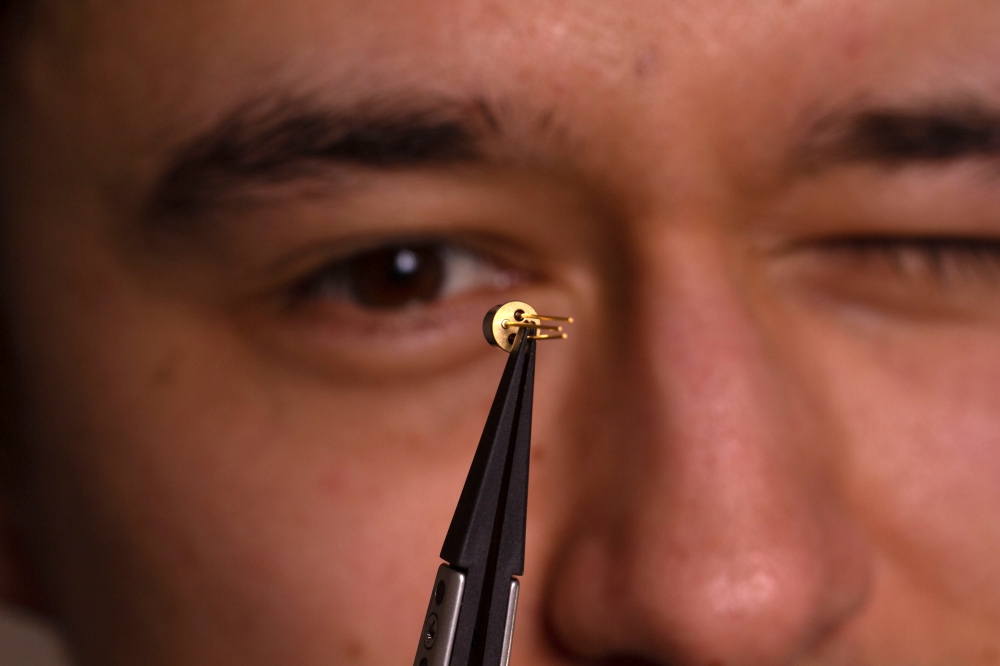
Phlux Technology, a manufacturer of avalanche photodiode (APD) infrared sensors, has announced that its patented Noiseless InGaAs infrared sensors, proven in demanding defence, telecoms and industrial applications, are now being evaluated for use in premium hunting and professional shooting optics.
Designed to detect extremely faint infrared signals around 1550 nm, Phlux’s InGaAs avalanche photodiode (APD) technology delivers an order of magnitude higher sensitivity than conventional near‑infrared detectors. This leap in performance, first adopted in laser range finders (LRF) in the defence industry and optical test equipment for fiber‑network monitoring, is now drawing the attention of manufacturers of top‑end laser rangefinders, integrated ballistic scopes, and specialist low‑light targeting systems for serious hunters and professional marksmen.
Special versions of the detectors have now been developed for these applications and Phlux has partnered with manufacturers of 1550 nm high-power lasers to support optics makers in end-to-end product development.
“Professional hunters and precision shooters are pushing their equipment harder than ever for smaller targets, more marginal light, tougher weather, and more complex backgrounds,” said Stuart Sendall, Phlux’s head of sales. “They are telling us the same thing we hear from telecoms and defence customers: they need better range and more detail and accuracy in detecting infrared signals. Our sensors are designed to unlock that extra margin of performance.”
Modern hunting and shooting optics increasingly rely on laser range finding and digital fire‑control to support ethical, first‑round hits at extended distances. By operating at around 1550 nm, an eye‑safe infrared wavelength, system designers can legally and safely use higher laser powers than when using traditional 905 nm devices, opening the door to longer ranging distances and more robust returns on difficult, low‑reflectivity targets such as dark game coats, brush‑obscured animals, or non‑cooperative backgrounds.
Phlux’s Noiseless InGaAs sensors are optimised for this 1550 nm band. The combination of ultra‑low noise and high internal gain means they can detect much weaker return pulses, allowing manufacturers to extend effective ranging distance without increasing laser power; maintain current range performance while shrinking optics and reducing power consumption; and improve ranging reliability in fog, drizzle, heat shimmer and low‑contrast environments where conventional receivers struggle.
For professional guides, night‑time pest controllers, and long‑range shooters working within tight ethical and regulatory constraints, this translates into more consistent range data and more confident decision‑making in the moments before a shot, according to the company.
Beyond stand‑alone rangefinders, premium optics makers are exploring Phlux’s sensors for integrated solutions that combine ranging, ballistic computation and imaging.
For instance, pairing a sensitive 1550 nm receiver with advanced optics and on‑board processing can support smart riflescopes that blend precise range data with ballistic profiles to give the shooter a more accurate hold point. Or it can enable compact binocular or monocular units that provide fast, repeatable ranging across real‑world targets rather than ideal reflective plates.
Another application is specialist professional and tactical‑style systems using 1550 nm for 'covert' illumination or aiming aids that are effectively invisible to traditional night‑vision devices tuned below 1 µm.
Phlux says it is now in discussions with leading optics and electro‑optics manufacturers serving the global hunting, precision rifle and professional pest‑control markets. The company is offering application support to help partners redesign receivers for 1550 nm, optimise optical layouts, and extract maximum real‑world range and reliability from the new sensors.