Genoa begins commercial shipments of linear optical amplifier
"This is a significant milestone for the optical communications industry," said Daryl Inniss, senior analyst with telecommunications research firm RHK. "With the ready availability of an optical amplifier that shares the cost-structure, potential for integration, mass production, and the scalability of the semiconductor industry, both the economics and the structure of future optical networks will change dramatically."
According to Rick Gold, president and CEO of Genoa, the LOA s potential has led to significant interest throughout the network community. "Our pre-production activity was unusually strong, in spite of the recent correction in the network market," said Gold. "LOAs have been sampled by companies around the world, from the name telecommunications giants to aggressive start-ups hoping to skip a generation of equipment."
Gold says the LOA has not only been designed into next-generation network products, but also into unanticipated applications. It s easy to understand this activity level, he says. "As new applications appear that shift processing to the optical layer of the network, they invariably become a new source of signal loss. The only antidote is gain, and the only source of gain is an optical amplifier."
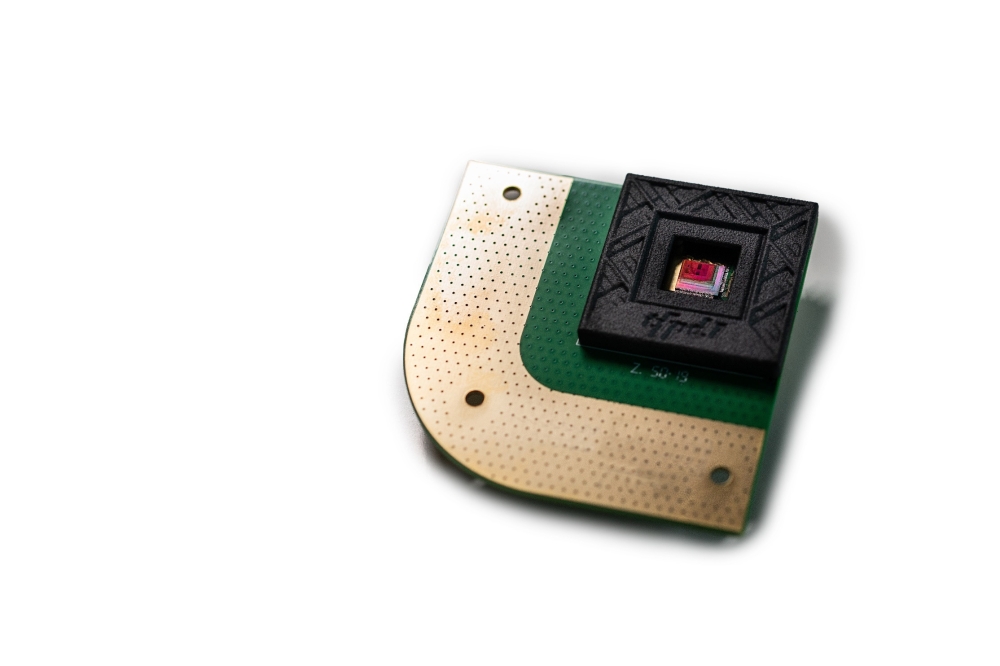
Traditionally, optical amplifiers, such as erbium doped fiber amplifiers or EDFAs have been used to boost the strength of light-based communications signals traveling down long optical fibers, typically between cities. The amplifiers used in this application are complex electronics modules, often costing between $15,000 and $50,000 each, that are about the size of a videocassette. Because of their great expense and awkward form factor, the incidence of such amplifiers, in relationship to the millions of miles of optical fiber in use, is very low roughly one amplifier for every 50 miles of fiber. Genoa s chip scale LOA offers much smaller from factors and makes it possible to use many such devices in a single piece of network equipment.
The LOA is being used for applications in receiver pre-amplifiers, lossless modules, inline and tributary amplifiers, and transmitter boost stages, says the company. Other non-amplifier applications may exist, said Gold, including all-optical wavelength conversion.
Genoa s first commercial optical amplifier, the G111 Linear Optical Amplifier, provides full C-band coverage and operates up to and beyond 40 Gbit/s in a full DWDM environment. The flat gain spectrum of the G111 provides faithful amplification in the multi-wavelength environment, without recourse to gain-flattening filters, and makes the LOA immune to transients in protection switching or add-drop applications. The LOA is available in a standard 14-pin butterfly package, suitable for integration into any line card in applications ranging from metropolitan and regional networks, SONET/SDH and IP systems, and optical networking nodes.
Paul Michelson
Roeder-Johnson Corporation (for Genoa)
Fax: +1650 593 5515
Tel: +1 323 874 4466
E-mail: paul@roederj.com
Web site: http://www.genoa.com