Hitachi Cable to produce gallium nitride substrates
The company will enter the market with a new method that allows it to mass-produce GaN substrates in 2-inch diameters with high uniformity. According to Hitachi Cable, its technique yields GaN substrates that exhibit 10,000 times fewer crystal defects than other methods.
In the new technique, a thin film of perforated titanium oxide is laid down on the sapphire base before the crystal GaN is grown on top. When cooled, the GaN layer is easily removed from the template.
New technique yields high-quality GaN wafers
The new technique is described in the Research Review section of the March 2003 issue of Compound Semiconductor magazine.
Researchers at Hitachi Cable in Japan have developed a novel technique called void-assisted separation (VAS) for preparing large-scale free-standing GaN wafers (Jpn J. Appl. Phys. 2003 Pt.2 (1A/B) L1).
HVPE growth of a thick GaN layer was performed on an MOVPE-grown GaN-on-sapphire template with a thin TiN film on the top. The TiN film had a net-like structure with hole sizes of 20–30 nm. This nanonet was self-assembled by annealing a Ti film formed on an MOVPE-grown GaN template by vacuum evaporation.
Numerous voids were generated around the TiN film during the HVPE growth. After cooling, the thick GaN layer was easily separated from the template with the assistance of the voids. As a result, a free-standing GaN wafer was obtained with excellent reproducibility.
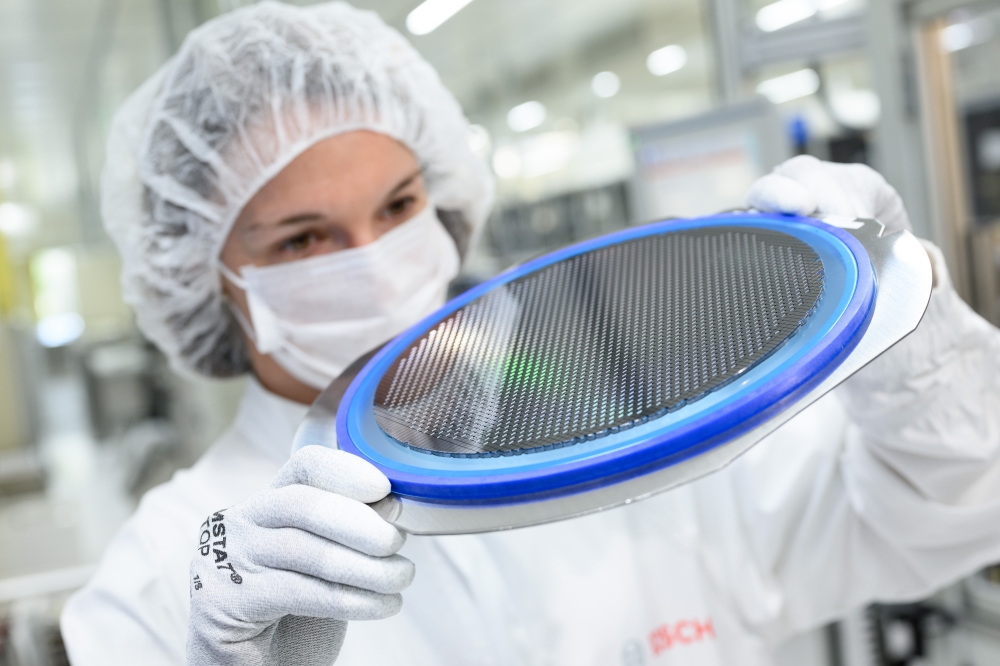
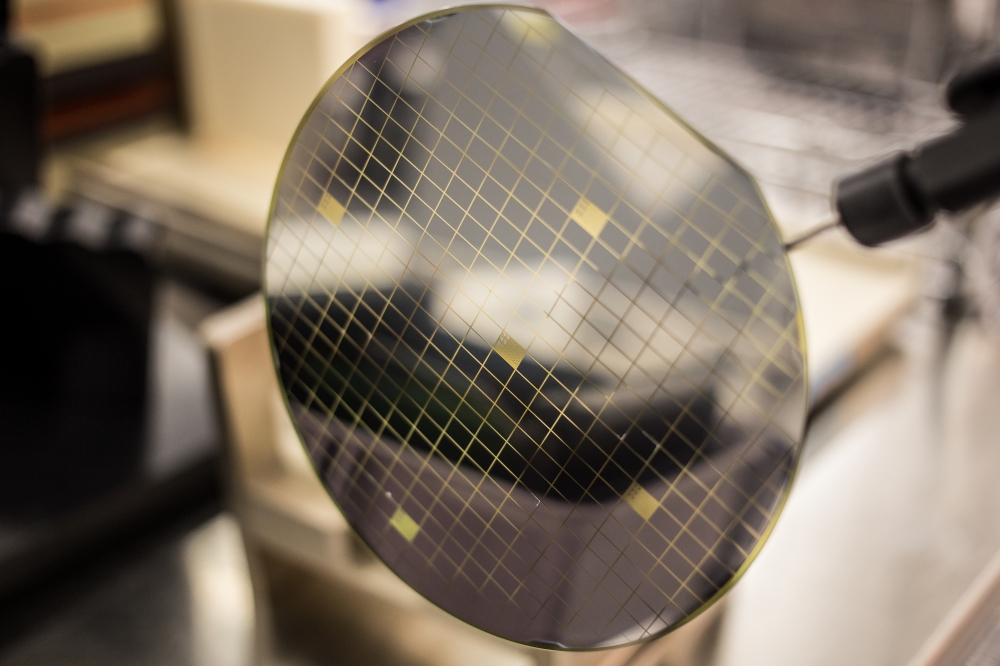
The free-standing wafer had a diameter of 45 mm, and a mirror-like surface. The FWHM of the (0002) and (10–10) peaks in the X-ray rocking curve profiles were 60 and 92 arcsec, respectively. The dislocation density was 4x106 cm-2 and was uniform over the wafer.
The researchers believe that the low dislocation density is the result of using the TiN film, which acts in the same way as the masks used in epitaxial layer overgrowth techniques. These results indicate that the VAS method is very promising for producing large-diameter GaN wafers with sufficient crystal quality to be used as a substrate for reliable laser diodes.