
SNU team develops novel wearable thermoelectric tech
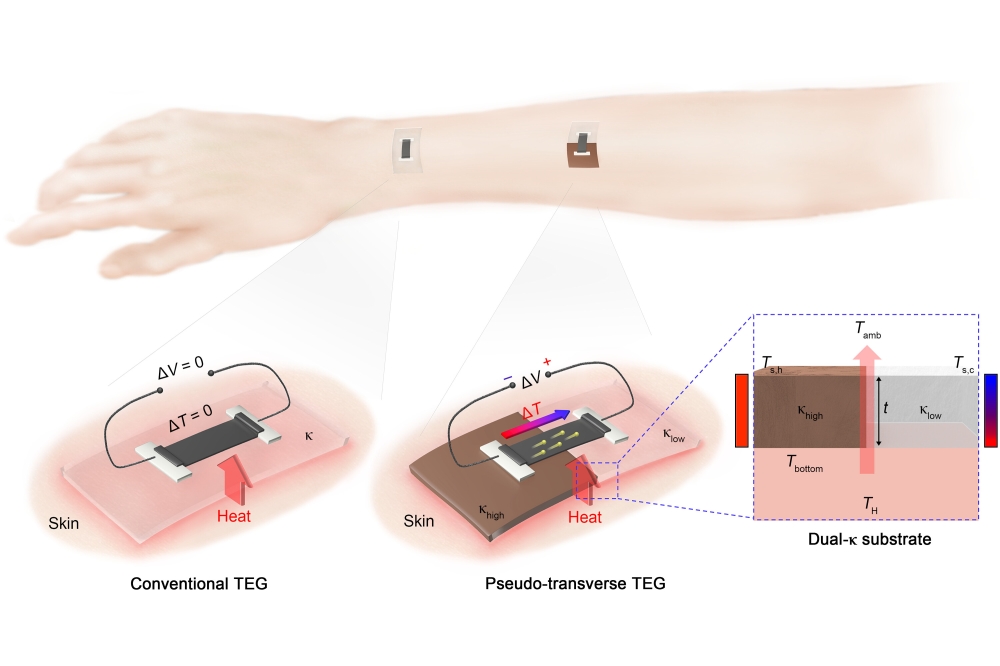
Researchers at Seoul National University College of Engineering have developed a flexible and thin 'pseudo-transverse thermoelectric generator' capable of producing electricity from body heat. Their findings were published in Science Advances.
The rapid advancement of soft wearable electronics has boostd demand for self-powered technologies that continuously harvest energy from the ambient environment. Thermoelectric generators (TEGs) offer one solution by supplying a direct current to devices by exploiting the constant thermal gradient generated by the human body, even without mechanical motion.
Thin-film TEGs using organic semiconductors show great promise when compared with TEGs based on bulkier inorganic compounds, due to low weight, low toxicity, cost-effectiveness, and easy fabrication. In addition, their thin and flexible nature allows excellent conformity to curved surfaces, such as human skin, minimising the thermal resistance between the heat source and the device.
However, this thin structure also presents a limitation. Thermoelectric generators require a temperature difference between hot and cold sides to generate electricity. When such a device is attached flat to the skin, body heat passes directly through the thin film and dissipates into the surrounding air — similar to heat passing through a sheet of paper. As a result, little to no temperature difference is formed across the device, making electricity generation difficult.
Previous studies have attempted to address this problem by bending the device or constructing three-dimensional, pillar-like structures. However, these methods increase thickness and volume, undermining the advantages of thin, flexible film-based devices.
To address this challenge, Kwak’s team proposed a new approach that fundamentally redirects the flow of heat. They successfully designed a 'dual thermal conductivity substrate' by incorporating thermally conductive copper nanoparticles into only selected regions of a stretchable silicone (PDMS) substrate, creating areas with high and low thermal conductivity within a single substrate.
When thermoelectric semiconductors are placed at the boundary between these regions, heat from the skin does not escape vertically but instead flows laterally along the high-thermal-conductivivity region. As a result, relatively warm and cool areas form on the substrate surface, creating a temperature difference that enables electricity generation even in a thin-film structure.
Through this approach, the study is the first to demonstrate that electricity can be generated even in thin films by maintaining a temperature difference through a new substrate structure that redirects heat flow. The research team named this technology a “pseudo-transverse thermoelectric generator,” as it structurally mimics the conventional transverse thermoelectric effect.
The developed wearable thermoelectric generator can convert body heat into electricity even in a completely flat configuration, without requiring bending or structural deformation. It is fabricated using an ink-based printing process, ensuring high flexibility. Additionally, the device offers scalability, allowing its size and shape to be freely designed and scaled up easily, similar to assembling modular blocks.
These features are expected to allow the pseudo-transverse wearable thermoelectric generator to be widely used as a self-powered energy technology for various devices, including smart clothing, health monitoring sensors, and wearable electronics.
Jeonghun Kwak, a professor at the Department of Electrical and Computer Engineering who led the work said: “This study addresses the limitations of conventional thin wearable thermoelectric generators through a new structural approach that controls heat flow,” adding, “Its significance lies particularly in presenting a new thermoelectric platform capable of generating a temperature difference while maintaining a fully planar structure.”
He added, “This technology has strong potential to be used as a power source for a wide range of wearable sensors and electronic devices that can be attached to the skin or clothing.”