
Seeing clearly even in the fog
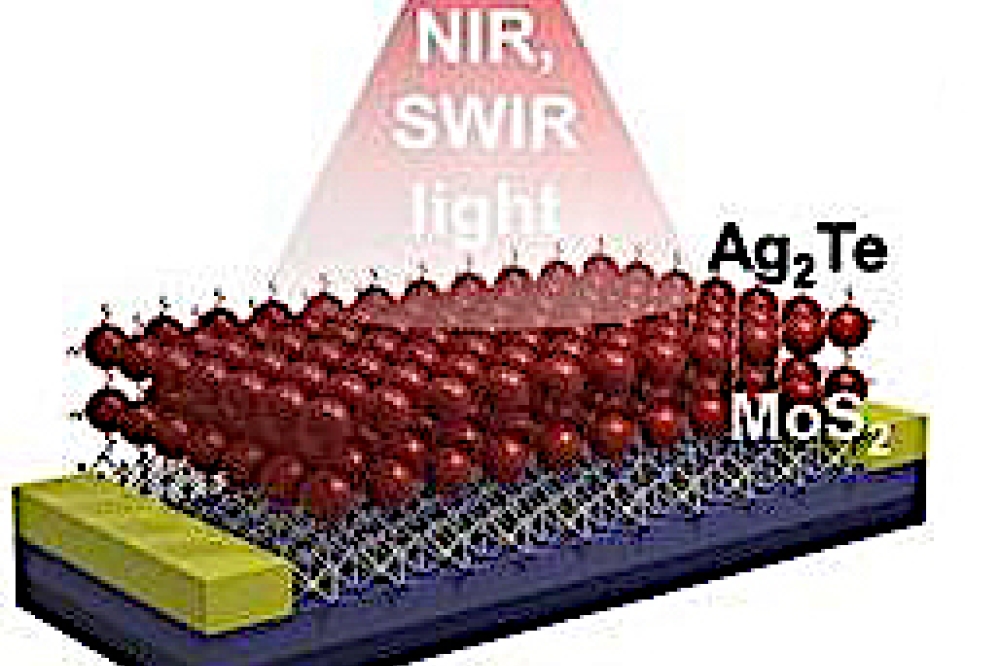
A research team led by Jong-Soo Lee of the Department of Energy Science and Engineering at DGIST, with Min-Chul Park’s team at the Korea Institute of Science and Technology (KIST) and Yonghoon Kim’s team at the Korea institute of Materials Science (KIMS), has developed a next-generation near-infrared image sensor technology that combines quantum dots with 2D semiconductors.
The work 'Device-scaling constraints imposed by the van der Waals gap formed in 2D materials' was published in the journal Advanced Materials.
Infrared sensors that detect the short-wave infrared (SWIR) region can clearly recognise objects not only during the day and at night, but also in fog or smoke, making them a key component for technologies such as autonomous vehicles, robotics, night surveillance, and medical imaging. However, conventional sensors are typically made using expensive semiconductor materials (e.g., InGaAs), resulting in very high fabrication costs and posing critical limitations in scaling to large-area devices.
To address this challenge, Jong-Soo Lee’s research team proposed a hybrid photosensor architecture that combines Ag₂Te quantum dots, which exhibit strong light absorption, with an MoS₂ 2D semiconductor known for its fast charge transport. The 2D semiconductor compensates for the inherently slow charge transport of quantum dots, thereby maximising the advantages of each material and presenting a new alternative.
The team successfully achieved significant amplification of the optical signal by employing the photodoping effect that occurs at the interface where the two materials meet under illumination. As a result, the developed sensor exhibited a high responsivity of 7.5 × 10⁵ A/W and a detectivity on the order of 10⁹ Jones, demonstrating excellent sensitivity capable of rapidly and accurately detecting even very weak infrared signals.
Furthermore, the team directly fabricated an infrared image sensor array consisting of 32 × 32 pixels beyond single-device demonstrations, confirming its capability for real image acquisition. This result demonstrates that the developed technology can be integrated with conventional CMOS-based semiconductor processes and holds strong potential for immediate commercialisation as a low-cost, large-area next-generation SWIR camera and image sensor.
“By combining the high light-absorption characteristics of quantum dot materials with the fast charge transport properties of 2D semiconductors, we were able to overcome the fundamental limitations of conventional infrared sensors,” said Lee. “This technology is expected to serve as a key foundational technology for the development of high-resolution infrared cameras and next-generation intelligent photosensor systems.”