IDTechEx forecasts $48b PIC-based transceiver market by 2036
IDTechEx’s has released a research report 'Silicon Photonics and Photonic Integrated Circuits 2026-2036' that forecasts sales of PIC-based optical transceiver transceivers (across all speeds) will reach $48 billion by 2036, with CAGR of 21.9 percent.
PICs are seen as the way to break bottlenecks caused by AI and high-performance computing workloads that require tremendous amounts of information to be transmitted at high speeds between chips, servers, and racks.
The holy grail is a monolithic silicon chip that generates, processes, modulates, and detects light all on a silicon chip. However, silicon is an indirect bandgap semiconductor, meaning a pure silicon laser is impossible to build. This physical constraint has motivated the development of an entire industry of photonics with various material platforms, integration techniques, and designs.
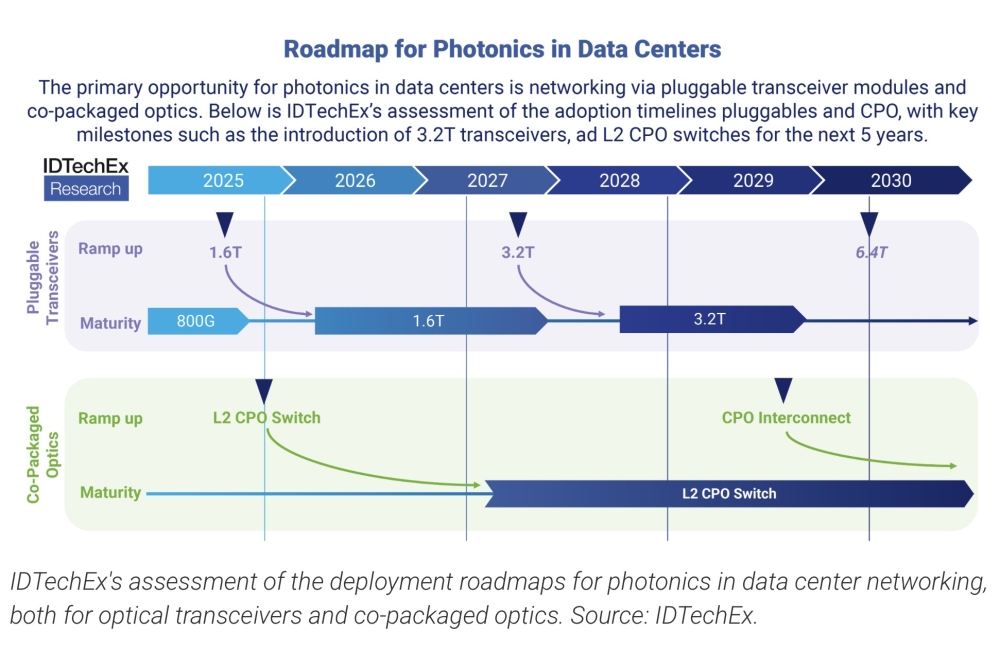
Data rates for optical transceivers have been doubling every few years, going from 100G through to 200, 400, 800, and as of 2026 1.6T systems. This doubling of data rate has also been accelerating, and IDTechEx expects that 3.2T systems will begin small-scale sampling and production around 2027 before reaching commercial ramp-up around 2028. This doubling of data rate has been made possible with PIC technology, and the enormous capital expenditures associated with the AI buildout, of which networking receives a significant slice.
As data rates climb, eventually even the short copper trace between the optical engine and the ASIC (application specific integrated circuit) begins to limit performance. The solution is to shift the optics closer to the ASIC, packaging the optical engine on the same substrate. To enable this, the photonics industry has developed a range of silicon photonic modulators and ultra high-powered lasers designed to meet the challenging thermal demands of integrating a laser with a heat-generating ASIC. 'Silicon Photonics and Photonic Integrated Circuits 2026-2036' dives into the leading solutions, such as the TSMC COUPE platform and the race to commercialise co-packaged-optic solutions (CPO-ready ultra-high powered lasers).
The report highlights a rapidly evolving landscape. Late 2025 into early 2026 saw a flurry of deals, with Marvell acquiring Celestial AI and NVIDIA investing $2 billion in Coherent and Lumentum each, a marked sign of the investor appetite for the optical component industry.
According to the report, the photonic datacoms revolution is spurring the development of an entirely new ecosystem. For optical transceivers, this shift has been driven by an insatiable demand for volume and lower margins. Chinese players, such as Eoptolink, adopt a strategy of buying components (such as lasers) from leading global suppliers and integrating and packaging the transceivers at low margin but enormous volume.
By contrast, American companies like Lumentum and Coherent are more vertically integrated, controlling the supply chain from InP epitaxy to final product assembly. However, all of these companies have identified Southeast Asia as a key manufacturing hub, with Chinese players seeking to avoid potential American tariffs and US players seeking lower manufacturing costs.