
Record forward-current for AlGaN Schottky barrier diodes
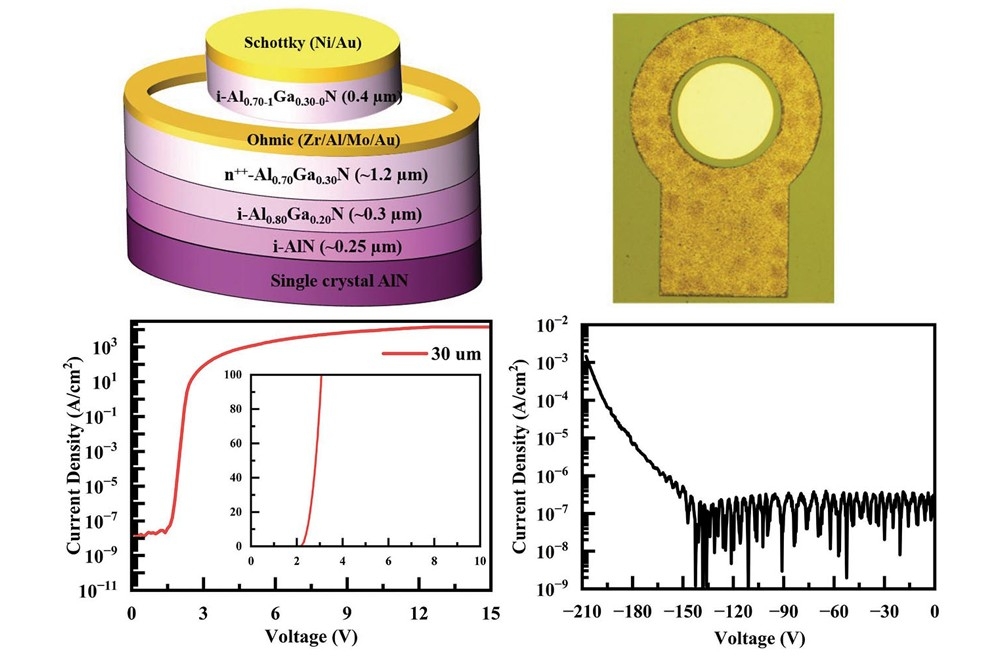
Engineers from the University of South Carolina are claiming to have broken the record for the forward current in Schottky barrier diodes based on high aluminium-content AlGaN material systems.
These quasi-vertical diodes, featuring distributed polarisation doping, deliver current densities of more than 8 kA cm-2 and 14 kA cm-2 under forward biases of 10 V and 15 V, respectively.
A key feature of the team’s AlGaN diodes is their foundation, a bulk AlN substrate. This platform, lattice-matched to the diode material, offers excellent thermoconductance. “But bulk AlN crystal is a dielectric,” explains corresponding author Tariq Jamil. “Making it highly conducting is a very challenging problem.”
Due to this limitation, Jamil and co-workers do not try to produce vertical Schottky barriers diodes, as their fabrication is far from easy – for example, it would require the use of complex processing to etch vias in the substrate that reach the anode layer.
Jamil argues that one of the merits of aluminium-rich AlGaN quasi-vertical devices is that they can be fabricated over any substrate supporting the growth of high aluminium-content material. “In addition, quasi-vertical devices fabricated over insulating substrates allow for simple integration with many other electronic and/or optoelectronic devices.”
According to the team, they are the first to use distributed polarisation doping to produce an n-type region in quasi-vertical AlGaN Schottky barrier diodes. Note, though, that this form of doping is not new, having been proposed as far back as 2002. Since then, it’s been applied to laser diodes and LEDs emitting in the UV, and to FETs and p-n diodes.
Fabrication of the quasi-vertical diodes began by loading a chemically cleaned bulk AlN substrate into an MOCVD reactor and, after annealing under ammonia, growing an epitaxial stack comprising a 0.25 µm-thick AlN buffer, a 0.3 µm-thick undoped layer of Al0.8Ga0.2N, a 1.2 µm-thick Al0.7Ga0.3N heavily silicon-doped layer, and a 400 nm-thick n-type distributed polarisation doped layer. For the latter, aluminium content is graded from 0.7 to 1.0.
Off-axis (1012) spectra obtained by X-ray diffraction have peaks with a full width at half-maximum of around 126 arcsec for the heavily doped Al0.7Ga0.3N layer and 70 arcsec for the AlN layer. These values indicate that the heterostructure is almost pseudomorphic.
To validate polarisation doping within the device, the team produced a similar structure, omitting the 1.2 µm-thick Al0.7Ga0.3N heavily silicon-doped layer. Doping measurements with a mercury-probe capacitance-voltage system revealed that despite any external doping, average donor density in the distributed polarisation-doped layer is around 8.5 x 1017cm-3.
Jamil and co-workers fabricated Schottky barrier diodes with standard circular mesa geometry featuring an n-type Zr/Al/Mo/Au contact and a Ni/Au Schottky contact. Both contacts were formed by electron-beam evaporation.
Electrical measurements determined that under a 15 V forward bias, current density is 14 kA cm-2, and effective current density – that’s the diode area where the current actually flows – is 36 kA cm-2. Reverse breakdown voltage, realised without passivation and field plates, is 210 V.
One of the team’s next goals is to fabricate more advanced devices, such as multi-finger geometry devices, that ensure more uniform current spreading and ultimately enable an increase in total current capability. Another aim is to achieve the highest possible reverse voltage.
“Both high forward currents and high reverse voltages are essential for applications of these diodes in power electronics,” says Jamil.
Reference
T. Jamil et al. Appl. Phys. Lett. 128 133501 (2026)