

AI and the future of epitaxy
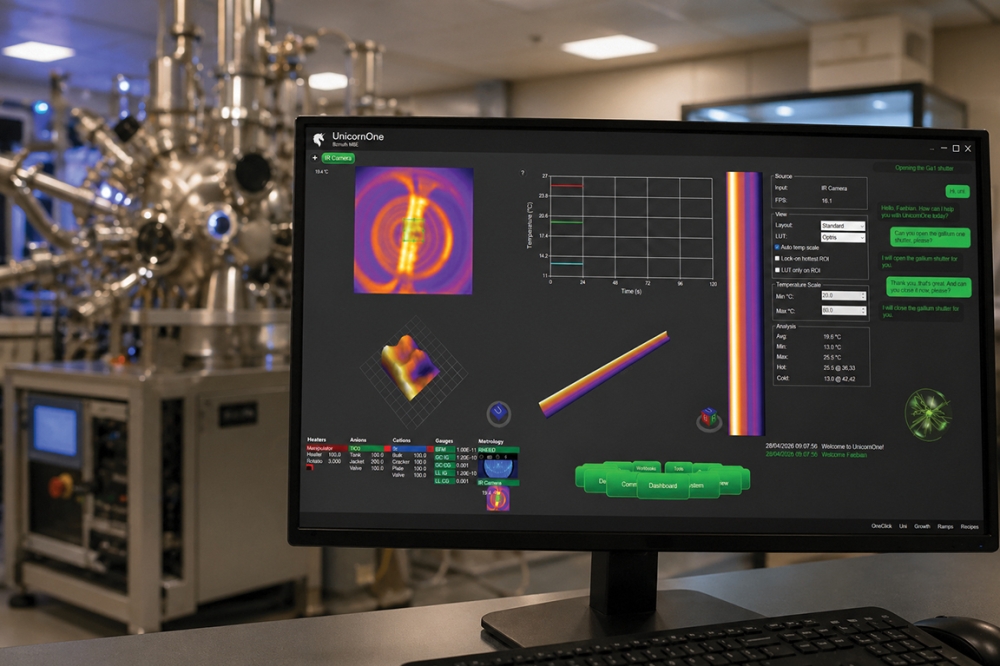
The challenge of applying AI to semiconductor manufacturing is not technological, but structural – and ultimately human.
BY Faebian Bastiman AND ISABELLA LORENTE FROM BIZMUTH MBE
A year ago, we started tackling a problem that many within our industry have been mulling over, but few addressing directly: how to bring AI into epitaxy in a manner that actually delivers.
At that time, we had a plan, along with a strong point of view and an exceptional partner in the Paul-Drude-Institute for Solid State Electronics, Leibniz-Institute in Forschungsverbund Berlin e.V. It’s a laboratory that’s been performing at the cutting edge of MBE research since 1992. What we did not yet have was proof that our approach would work.
Over the past year, that’s changed. Working directly on operational systems under real-world conditions, we have tested our ideas where they matter the most: on the tools, with the data, and within day-to-day workflows.
Our original aim was a modest one: to determine whether it’s possible to integrate AI into the process in a way that provides consistent, measurable benefit. But our ambitions did not stay modest for long.

Project UnicornOne members from PDI and Bizmuth.
A real-world problem
For our work, we chose GaN deliberately. It’s central to modern devices – LEDs, lasers, and power and RF electronics – it’s widely studied, and it is still difficult to handle in practice. When combined with MBE, a precise but unforgiving growth technique, we had a combination that provided an ideal proving ground for our AI ambitions.
Our aim was clear. Optimise the GaN growth window on one system, then replicate it on others. On paper it’s a simple objective. And if we achieved it, we could naturally extend our approach beyond MBE to other deposition techniques, including CVD, ALD, and PVD.
With hindsight, the real difficulty was never going to be GaN or MBE. It was something more intangible.
GaN is hard, but it’s not unknowable. The physics is largely understood. Far less defined is how to apply that knowledge. Much of the process remains tacit, embedded in the experience of the operator, rather than captured in the system.

Unicorn One’s build in RHEED analysis tool.
Another impediment to introducing AI is that the systems offer little support. Data is fragmented, units are inconsistent, and tools operate in isolation. While information exists, it is difficult to align, interpret, or reuse in a meaningful way.
This results in a self-reinforcing problem loop: GaN MBE remains difficult, because the knowledge is not fully captured. And that’s the case, because systems are not designed to hold it. Instead, the process continues to rely on experienced users, bridging the gaps.
Our solution breaks this cycle. We have built a system that’s capable of integrating data, workflows and AI into a coherent whole. It’s an approach that breaks new ground, tackling the problem with full visibility of the process and its limitations.
Success has come from having a clear idea of what’s there, and equally important, what’s missing. Regarding the latter, there’s nothing new. For decades, our industry has been held back by omissions quietly undermining progress across systems, workflows, and data.

Unicorn One’s GaN temperature calibration AI/ML workbook.
Integration is key
In a world of vendor-locked software, fragmented data and isolated tools, AI cannot operate effectively. Under this modus operandi, AI only analyses individual datasets, and cannot participate in the process itself.
In the months leading up to the work with PDI, and with this constraint in mind, we started developing our new software and LabOS ‘UnicornOne’. We knew that if AI was to play a meaningful role, integration could not be an afterthought. It had to be the foundation. This meant that we would have to unify hardware, data, and workflows into a single, coherent system – one where humans and AI could observe, reason, and act.
As well as providing insight, our collaboration offers proof. Working directly on operational systems, we began by confirming the scale of the problem. Prior to our efforts, legacy tools, modern instruments, and external data sources existed side by side, but rarely in communication. Data was present, but not structured. Control was possible, but not unified.
Addressing these issues, we constructed a unified control layer, UnicornOne, sitting across these systems. Rather than replacing them, it joins the dots, creating a consistent interface that captures all actions and measurements in a structured, time-resolved form.

UnicornOne’s multi AI mesh and physics solvers.
Building the AI system
With a strong foundation in place, we embarked upon the next challenge, data.
While real experimental data is valuable, it is inherently slow to produce and difficult to scale. A single iteration may take hours, and exploring a parameter space exhaustively is rarely practical in a laboratory setting.
So, rather than waiting for more data to accumulate, we took a different approach, focused on generating it.
Starting from a small, annotated dataset, featuring Reflection High-Energy Electron Diffraction (RHEED) images and videos, we developed a simulation framework capable of reproducing the key features of the growth process under controlled conditions. This real data provided the anchor, with simulation ensuring rapid expansion, allowing datasets to be extended, refined, and reused at speed.
From this point on, progression became relatively straightforward. We combined real and synthetic data into coherent datasets, which supported model development without the need for extensive experimental repetition.
Models naturally followed from this foundation. They were lightweight and targeted, trained not in isolation, but part of a wider system that’s designed to reflect how an engineer would approach the same problem. In situations where physics is well understood, it’s applied directly; and where interpretation is required, AI provides support. This leads to a hybrid approach, deterministic where possible, stochastic only where necessary.
The result is not a single AI model. Instead, it’s a multi-model system, combining stochastic and deterministic elements, integrated within a software environment supporting human and machine decision-making. To accomplish this, we divided the growth process into a series of discrete subtasks – each one interpretable, executable, and aligned with how a researcher would approach the same problem.
With our multi-model system in place, determining and reproducing the GaN growth window was no longer a theoretical question. It had become operational.

UnicornOne’s adaptive RHEED image pipeline for storage, humans and AI.
Real world deployments
At this stage, we shifted our focus to proving that the system could be deployed quickly and reliably. Thanks to our vendor-agnostic hardware abstraction layer, we could interface with existing tools without modification, reducing the installation time from weeks to days.
When embarking on this task, long-hidden issues surfaced – configuration inconsistencies, communication faults, and components operating outside intended conditions. These problems were caused by fragmented software and limited visibility, and addressing them became part of the deployment. As we worked through the problems, systems were not just integrated, but improved.
After establishing the interface, we deployed the workflow. Despite emerging real-world constraints, including electrical noise affecting RHEED signals, we had a smooth transition. As the process had already been developed and validated in simulation, and grounded in real conditions, little adaptation was required when applying it to the physical system.
The system, workflows, and subtasks have operated as intended, delivering an immediate impact. A GaN growth calibration, previously requiring around two and a half hours of manual effort, can now be completed in about thirty minutes.
We then deployed the same workflow on a second system, made by a different vendor and featuring a different configuration. Another accomplishment, with successful execution on the first run.
This was the key moment. It demonstrated that, with consistent physical units and a sufficiently abstracted control layer, it’s possible to transfer workflows between systems without modification. In effect, the process had become portable.
By now our efforts were paying dividends. Based on Bizmuth’s calculations, time savings alone were translating into a trimming of annual operating costs by around €55,000 per system for this single workflow, with reproducibility built in by design.
Compounding interest
As the system matured, its role expanded. Researchers at PDI started developing their own workflows, referred to as ‘workbooks’, to address specific tasks. They included tools for mapping parameter spaces, calibrating nitrogen flux based on mass flow and plasma conditions, and replaying historical data to generate new training datasets.
Further extension to this platform has come from support for Python-based workflows and external APIs. Users have been given the opportunity to integrate custom scripts, connect external tools, and build more complex pipelines on top of the core system.
What began as a solution to a specific problem has now evolved into a more general environment for conducting and managing experiments.
One of the more interesting outcomes of our development has been its effect on how researchers approach their work. For routine automated tasks, such as calibration and monitoring, time has been created for observation and analysis. Now subtle variations in RHEED signals, possibly previously overlooked, are the basis for new lines of investigation. With this superior way of working, the system is not replacing the researcher, but changing the nature of their engagement with the experiment.
By combining structured workflows, historical data, and large language models, it’s now possible to interpret high-level intent and translate it directly into execution. Users no longer define every step. Instead, they define the outcome – and the system plans, selects, and acts.
With this way of working in place, AI has moved on from simply helping to solve a problem to taking the reins and growing a whole sample.
That’s possible, thanks to our strong foundation: integrated systems, structured data, documented processes.
While we are still at an early stage, our approach demonstrates the huge potential for more autonomous operation. Complex tasks can be coordinated across multiple components, with feedback loops ensuring that the process remains aligned with the intended outcome.
The broader reality
Alongside many breakthroughs, the experience at PDI has highlighted a critical limitation: adoption has not been uniform across all users and systems. While some embrace the platform and extend it in new directions, others are more cautious.
This state of affairs is not that surprising. It reflects a broader reality within the semiconductor industry, which is that barriers to adopting AI are rarely technical. Playing a major role are established workflows, individual incentives, and concerns regarding transparency. For some, systems that make processes more explicit and reproducible change how expertise is perceived and shared, even valued.
Judged against backdrop, the challenge of applying AI to semiconductor manufacturing is as much human as it is technological. The foundations are already in place, as the tools required to build AI-enabled systems already exist. The greater challenge lies in integrating these tools into a coherent framework, and aligning that framework with the needs and expectations of its users.
Our efforts at PDI suggest that meaningful progress is possible. Focusing on integration, rather than isolated optimisation, we have created systems where AI operates effectively. Capturing data with sufficient context allows processes to be reproducible and transparent; and by providing extensible platforms, it’s possible to support standard workflows and innovation.
Looking ahead
The approach we have developed extends naturally beyond individual tools. By coordinating systems, integrating in-situ and ex-situ data, and aligning workflows, our methodology can be adopted by facilities, enabling them to operate as coherent units, rather than collections of independent tools.
It’s a transition that’s already underway at PDI, an institution pleased with progress, and we have agreed to expand the collaboration, but we cannot yet announce any details yet. What began with GaN on a single MBE system has expanded to now include oxides, complex materials, and traditional III-V processes, with multiple tools brought under a unified control framework.
Beyond MBE, we are applying our software to PVD and CVD through collaborations with equipment manufacturers, with the aim of establishing a consistent control layer across thin-film technologies.
The conclusion is clear. AI is not the limiting factor. What determines its impact is the infrastructure into which it is deployed, and the degree to which systems, data, and workflows are aligned. The future of semiconductor manufacturing will not be defined by AI alone, but by the systems that enable it – and by those prepared to adopt them.