
Combatting compositional pulling in red InGaN microLEDs
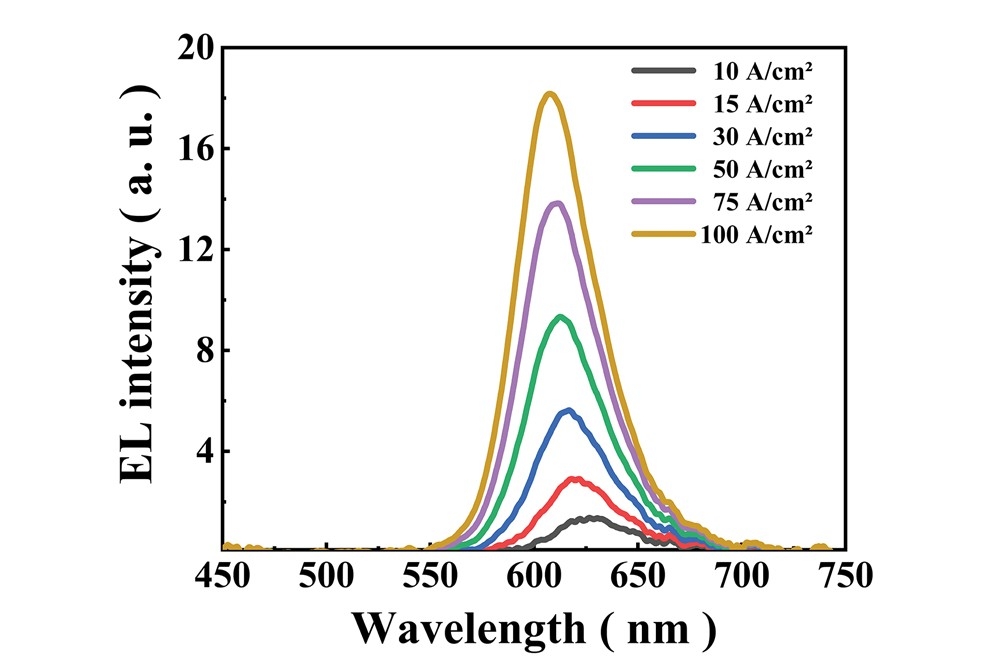
Through the setting of new standards for spectral purity and minimal wavelength shift, a Chinese collaboration is claiming to have improved the performance of InGaN red-emitting microLEDs.
This breakthrough – revealed by a partnership between Xiamen University, the Future Display Institute of Xiamen, and Southern University of Science and Technology – will aid the development of displays based on III-N microLEDs, which are held back by a strong and stable source of red emission.
Another potential material systems for producing red microLEDs is AlGaInP, the quaternary sitting at the heart of LEDs deployed in many applications. However, as the dimensions of this form of red LED shrink, its external quantum efficiency (EQE) plummets. For sizes below 5 µm, EQE is less than 1 percent, primarily due to Shockley-Read-Hall non-radiative recombination stemming from sidewall damage.
A more promising alternative is the InGaN microLED. Scaling the dimensions of this device, which also offer superior thermal robustness, is more
successful if proper sidewall passivation is applied. What’s more, as blue and green InGaN LEDs are well-established, there’s the potential to make full-colour displays from a single material system, eliminating material incompatibilities and simplifying display fabrication.
But there are issues with red InGaN microLEDs. They require an indium content that exceeds 35 percent, and due to an 11 percent lattice mismatch between InN and GaN, there’s significant compressive strain in the quantum wells. This strain degrades crystal quality and introduces strong piezoelectric fields that pull apart electrons and holes and hamper radiative recombination. Also at play is phase separation and compositional inhomogeneity, broadening emission from the LED and degrading its performance.
While the team from China are by no means the first to try and address the poor EQE of red LEDs, they have broken new ground for realising spectrally pure, single-peak red emission by combatting compositional pulling – it’s caused by compressive strain in the quantum wells, and leads to vertical inhomogeneity of the indium composition in the multi-quantum well region. When compositional pulling is not addressed, spinodal decomposition may result, creating a yellow or green shoulder in the emission profile of a red LED. This impacts spectral purity and colour stability, metrics that matter in display technologies.
To minimise compositional pulling, the team adjusts the growth temperature during deposition of the active region, with the first two quantum wells grown at a temperature 5 °C higher than the three remaining quantum wells. Note that team spokesman Hongjian Li, an affiliate of the Future Display Institute of Xiamen and Xiamen University, told Compound Semiconductor that a similar result may be realised by varying the flow of trimethylindium into the MOCVD chamber.
To quantify the consequences of compositional pulling effects, Li and co-workers employed cross-sectional cathodoluminescence to scrutinise a control sample, with all quantum wells grown at the same temperature. This technique revealed a distinct blue-shift of 15-25 nm between upper and lower quantum wells.
Further evidence for variations in indium content came from energy-dispersive X-ray spectroscopy, which determined a difference in indium content between the first and fifth quantum wells of the control of 12 percent. For the structure produced with different quantum well growth temperatures, indium content varies by just 4 percent.
The superior uniformity enabled the team’s 15 µm by 15 µm LEDs to produce a single red emission peak over a wide range of drive current densities, ranging from 1 A cm-2 to 100 A cm-2. Driven at 5.2 A cm-2, the researchers device delivers an EQE of 7.9 percent.
Li says that the next goal for the team is to increase the EQE of its InGaN red microLEDs and deploy them in full-colour displays with an ultra-high pixel density.
Reference
C. Liu et al. Appl. Phys. Lett. 128 191103 (2026)