
PureFize presents alternative Far-UVC technology
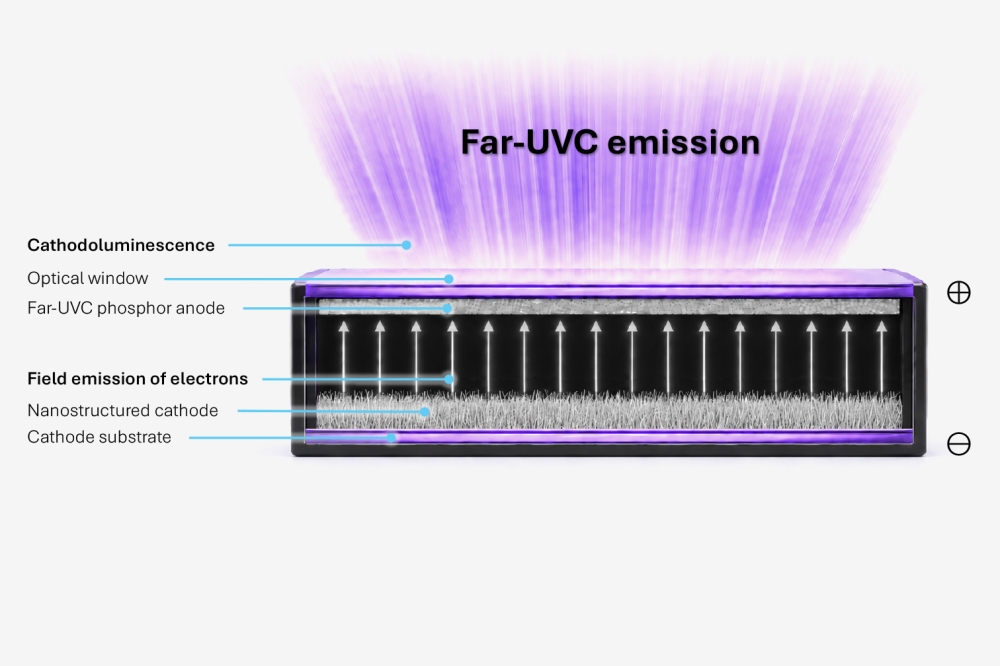
PureFize Technologies, a Swedish developer and producer of broad-spectrum UV technology, has presented new results at the International Conference on Far-UVC Science and Technology (ICFUST) 2026 demonstrating the feasibility of generating Far-UVC emission below 240 nm using the company’s field-emission and cathodoluminescence technology platform.
The presentation, delivered by Emma Eriksson, R&D, PureFize Technologies, introduced a new deep-UV radiation source concept that combines field emission from ZnO nanostructures with cathodoluminescent excitation of a Far-UVC phosphor layer. The company believes this approach represents a potentially important new direction in Far-UVC device development, complementing existing gas-discharge and semiconductor-based technologies.
Far-UVC is attracting increasing scientific and commercial interest because of its potential to inactivate microorganisms in air and on surfaces while offering a fundamentally different tissue interaction profile compared with longer-wavelength germicidal UVC.
However, broad market adoption will require technologies that can deliver the right combination of wavelengths, stability, manufacturability, cost, integration flexibility, and application-specific performance.
“Far-UVC is one of the most exciting areas in UV technology, but the field still needs new device platforms to support real-world adoption,” said Forssell. “Our results show that PureFize’s core technology is not limited to our current broad-spectrum UV products. It can also be directed toward Far-UVC, opening a path toward scalable, flexible and potentially application-specific device designs.”
The development work presented at ICFUST 2026 includes Far-UVC phosphor investigations performed in collaboration with FH Münster University of Applied Sciences, Department of Chemical Engineering, including work with Sc-doped and Pr-doped phosphor materials.
Early prototype characterisation presented by PureFize showed deep-UV emission below 240 nm; tuneable output power; wide-angle emission of approximately 100°; short start-up time; irradiance stability across a wide ambient temperature range; and measured irradiance of approximately 3.5 μW/cm2 at 1 m with 12 W total input power
PureFize emphasised that the work represents a milestone rather than a commercial product launch. “Far-UVC has enormous potential, but no single device architecture will solve every application,” said Fredrik Forssell, CCO and head of business development at PureFize . “We believe our technology can become an important product platform — especially where scalability, spectrum tuning, robust operation, and system integration are decisive.”
The company’s next development steps include continued material development, spectrum optimisation, system-level performance improvement, application tuning, and safety validation.
“Because our platform separates the electron-generation mechanism from the emitting phosphor material, it gives us a high degree of design flexibility,” said Eriksson. “This flexibility is particularly relevant for Far-UVC, where wavelength, spectral purity, optical output, thermal behavior, and application geometry all matter.”
PureFize’s existing broad spectrum UV product platform is already built around field emission and cathodoluminescence, using a scalable production approach developed and implemented at the company’s facility in Uppsala, Sweden. The company’s current broad-spectrum UV technology emits primarily in the UVC range, with additional UVB and UVA components, and is being developed for applications where microbial control, food safety, quality, and shelf-life extension are critical.
With the new Far-UVC results, PureFize sees an opportunity to expand the role of its platform into next-generation UV disinfection systems.