
News Article
Far-UVC LEDs deliver record-breaking performance
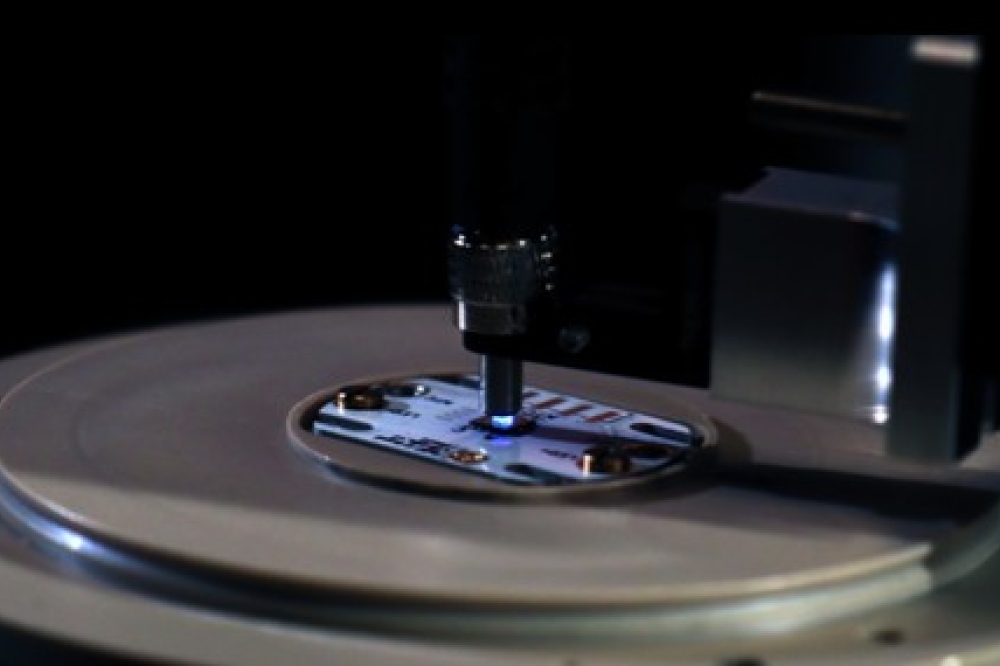
FBH µLED development paves the way towards compact medical light sources that can inactivate pathogens in body cavities
Each year thousands of people die from multidrug-resistant organisms (MDROs), such as MSRA, acquired in hospitals. But one potential approach to killing these harmful microorganisms is the use of far-UVC wavelengths below 235nm.
Now the Ferdinand-Braun-Institut (FBH) in Berlin has reported exceeding an important threshold in making this technology more widely applicable. It has announced 1 milliwatt of output power using far-UVC LED light sources in continuous wave (CW) operation from a single fibre – an international record that was recently presented at a conference.
The breakthrough research, driven primarily by the work of Jens Rass, was achieved using 235 nm UV micro-LEDs arranged in a dense array, allowing five times more light to be coupled into the fibre than with conventional far-UVC LEDs. The micro-LEDs themselves, of which up to 125,000 are arranged on a chip measuring one square millimetre, are compact with diameters of only around 1.5 µms. Importantly, the light source is also directional.
Sven Einfeldt, research group leader at the FBH, who has many years of experience in the development of UVC LEDs for medical applications, explains: “With these very short-wave LEDs, we were able to demonstrate international record values in terms of efficiency and performance – a real breakthrough. Together with partners, we now want to take the next step from the laboratory to practical application with a prototype.”
The Berlin-based institute has already developed 233 nm UVC LEDs for panel irradiation systems that have been applied directly to human skin. Extensive studies conducted within two BMFTR-funded projects at Charité – Universitätsmedizin Berlin and Universitätsmedizin Greifswald have confirmed the effectiveness of the treatment and that it does not cause any lasting damage to the skin.
The longterm vision is to be able to make light sources for disinfecting the nasopharyngeal cavity for eradicating multi-resistant germs and also for disinfection in other body cavities. One milliwatt LED irradiation sources, according to the researchers, could provide irradiation times of around five minutes without significant heat generation.
“This would allow us to inactivate MDROs in their habitats, which have been difficult to reach until now. After disinfecting the entire body with special washing lotions and mouthwashes, it would be possible, for example, to completely eliminate MRSA bacteria," explained Martina Meinke, head of the Centre for Skin Physiology at Charité's Department of Dermatology, Venereology, and Allergology.