
Strength in numbers: The glorious GaN VCSEL array
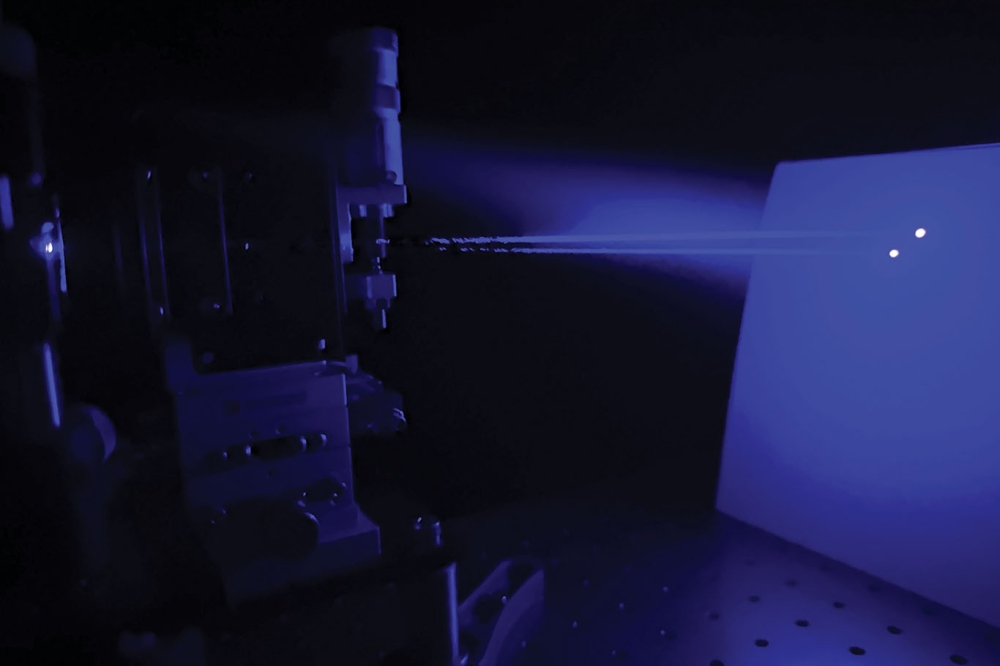
GaN-based VCSEL arrays are emerging as a disruptive platform for next-generation displays, sensing, and optical communications, offering a unique combination of high brightness, spectral purity and scalability.
BY KENTARO HAYASHI FROM SONY SEMICONDUCTOR SOLUTIONS
The VCSEL is an indispensable source in modern optoelectronics, where it is valued for its high beam quality, low threshold current, and compatibility with wafer-level processing.
Unfortunately, today’s commercial VCSELs tend to be restricted to the GaAs and InP material systems, confining their operation to the infrared. It is a limitation that holds back the number of applications where they can serve, and prevents their uptake in situations where a compact source emitting in the visible or ultraviolet is essential.
Overcoming this issue is the GaN-based VCSEL, which extends the spectral domain of this source into the visible and even the ultraviolet. Reaching these shorter wavelengths enables multiple GaN VCSELs, in the form of arrays, to be a disruptive technology – they can push boundaries in displays, sensing, lighting, and communications.
While commercial adoption of the GaN VCSEL is still in its early stages, rapid research breakthroughs are accelerating progress, bringing practical devices closer to reality.

Figure 1. Comparison of optical mode confinement in planar-mirror
and concave-mirror VCSEL cavity structures. In the planar configuration,
the optical mode tends to spread outward, especially in longer
cavities, resulting in increased diffraction losses. In contrast, the
concave-mirror design effectively confines the mode within the cavity,
significantly reducing losses and enabling extended cavity lengths
without performance degradation.
Producing VCSELs with the GaN material system is challenging. Difficulties stem from the inherent complexities of GaN crystal growth and, in particular, the fabrication of mirrors – in this class of laser, they take the form of distributed Bragg reflectors (DBRs), providing the optical confinement necessary for lasing. Today it is relatively straightforward to manufacture the AlGaAs/GaAs DBRs deployed in infrared VCSELs, but it is far more challenging to construct those made from AlInN/GaN multilayers, the obvious candidate for GaN-based VCSELs. Here, there are significant hurdles to overcome when producing mirrors that combine a high reflectivity with a low defect density.
Helping to overcome these barriers are recent advances in epitaxial growth techniques, heterostructure design, and strain management. Researchers have demonstrated GaN VCSELs that deliver stable operation in the blue-violet, blue and green, with output powers and lifetimes rapidly approaching practical levels. These milestones have established GaN VCSELs as not only a pathway to compact visible lasers, but as a foundation for entirely new device architectures.
Why arrays matter
While single GaN-VCSEL devices are already promising, their disruptive potential emerges when they are integrated into dense two-dimensional arrays, an approach we are pursuing at Sony Semiconductor Solutions Corporation, where we draw on our novel long-cavity GaN-based VCSEL technology.
Employing battalions of VCSELs in arrays enables a scalable output power, spatial beam shaping and multi-wavelength integration. These are much-valued advantages that extend well beyond the capabilities of individual emitters. For applications in microdisplays, adaptive lighting, optical communications and underwater sensing, array-level integration provides a versatile platform for next-generation light engines.
Unfortunately, scaling VCSELs into large arrays introduces new challenges, foremost among them thermal management. Despite the relatively high thermal conductivity of GaN substrates, densely packed arrays of VCSELs are prone to localised heating and thermal crosstalk. These issues impair efficiency, shift emission wavelength, and ultimately curtail device lifetime. Exacerbating these weaknesses are the epitaxial DBRs deployed in GaN-VCSELs – often based on AlInN/GaN multilayers – that are renowned for relatively high thermal resistances that magnify heat-dissipation issues.
To address these concerns, some researchers are exploring novel cavity architectures, alternative reflector designs and advanced packaging strategies aimed at trimming thermal resistance and ensuring stable operation under high drive currents. Such innovations are crucial to unlocking the full potential of GaN-VCSEL arrays, so that they can function as reliable, energy-efficient light sources across a wide spectrum of applications.

Figure 2. Sony has produced a 456-emitter GaN-VCSEL array structure.
Each emitter consists of a concave-mirror vertical cavity with an
InGaN/GaN MQW active region, current confinement via B+ ion
implantation, and transparent ITO electrodes. The array is fabricated on
a conductive GaN substrate with a device pitch of approximately 70 µm,
enabling high-density integration and a uniform layout.
Fabricating arrays
A typical GaN-VCSEL array consists of: an n-type GaN layer, grown on a GaN substrate; an active region composed of multiple quantum wells (MQWs); a p-type GaN layer; and two high-reflectivity DBR mirrors.
One of the weaknesses of conventional VCSELs is their planar mirrors, which are to blame for significant diffraction losses as the cavity length increases. To address this, our design incorporates a concave mirror on one side of the cavity. The primary advantage of the concave-mirror cavity is its ability to effectively suppress diffraction losses. As illustrated in Figure 1, planar mirror structures ensure that optical modes spread outward, especially in long cavities, resulting in increased losses. In contrast, our design confines the optical mode tightly within the cavity, using a concave geometry that significantly reduces diffraction losses. With our design, we can extend the cavity length substantially without compromising performance.
Our focus is on long-cavity designs. That’s a noteworthy difference from the architecture of the conventional planar-mirror VCSEL, which typically employs a short cavity to prevent diffraction losses. The major downside of short cavities is that they lead to a wide longitudinal-mode spacing, which poses several challenges. For instance, the gain spectrum of InGaN MQWs is relatively narrow, with a value for the full-width at half-maximum below 20 nm, and even slight variations in cavity thickness can cause the longitudinal mode to deviate from the gain peak. This results in an increased threshold current and a lower yield. For a GaN VCSEL with a 2 µm cavity, engineers must ensure a thickness control within ±10 nm, an extremely difficult requirement when employing chemical-mechanical polishing on GaN substrates.
Adopting a concave mirror structure is a game changer. This allows the cavity length to be extended beyond 20 µm, and narrows the mode spacing to approximately 1 nm. With these changes, it is much easier to align the mode with the gain peak, an advantage that increases design tolerance and improves device yield. The opportunity to extend cavity length without sacrificing performance also enables each emitter in the array to deliver sufficient optical output, maximising the overall performance of the array.

Figure 3. Current-voltage-output power characteristics of the
GaN-VCSEL array measured at room temperature. The array exhibits
threshold currents and slope efficiencies comparable to single-emitter
devices. A total optical output of 11 W is achieved under pulsed
operation (pulse: on 5 µs, off 95 µs, duty 5 percent), and 2.8 W under
CW operation, demonstrating the high-power scalability of the array
architecture.
Another advantage of our concave-mirror structures, with cavity lengths exceeding 20 µm, is that they have around half the thermal resistance of the more common planar-mirror structures. Thanks to the superior thermal characteristics of the concave design, we enjoy structural advantages for high-power operation in array configurations.
Fabrication of our concave mirrors begins by forming a photoresist pattern on the back side of a GaN substrate. Subsequent heating transforms this resist into a spherical shape, thanks to surface tension. This spherical resist provides a mask for reactive ion etching, which transfers the desired curvature directly onto the GaN surface. We deposit a dielectric DBR multilayer directly onto the lens-shaped GaN surface to create a lens with a root-mean-square roughness of just 0.3 nm – this low value minimises scattering losses.
Our concave-mirror GaN-VCSEL includes an InGaN/GaN MQW active region for efficient blue emission. We then form a current-confining layer via B+ ion implantation, a step that enables the fabrication of devices with a designed aperture diameter of 4 µm. The addition of indium tin oxide provides a transparent electrode, and ensures efficient p-side light extraction and lateral current spreading. Our DBR, consisting of 14 pairs of SiO₂/Ta₂O₅ on the n-side and 7.5 pairs on the p-side, provides high reflectivity. The n-side DBR is selectively removed by dry etching, except at the lens apex, prior to n-electrode deposition that optimises optical and electrical performance. With this design, light is primarily extracted from the p-side. Using this VCSEL architecture, we have fabricated arrays with 456 emitters and a device pitch of approximately 70 µm, an architecture providing a uniform layout and a high integration density (see Figure 2).
Measurements of this VCSEL-based 456-emitter array reveal that we can produce 2.8 W under CW operation and 11 W using pulsed conditions – that’s with pulses with a duration of 5 µs, and a 5 percent duty cycle. These results demonstrate the scalability and high-power capability of our concave-mirror VCSEL architecture (see Figure 3).

Figure 4. Passive matrix wiring structure is employed in the VCSEL
arrays. Here is shown the emission mode for individual VCSEL driving.
Current injection is 3 mA, under room-temperature CW operation.
Addressing the individual
In lighting and displays, VCSELs offer a significant advantage over conventional LEDs, thanks to their narrow beam profiles, high output power and high-frequency operation. It’s possible to produce compact lighting systems by combining blue light from a GaN-based VCSEL array with a yellow phosphor. One of the promises of this VCSEL-based lighting technology is that it could serve as a light source for optical communications in areas where Wi-Fi cannot be used. Meanwhile, if GaN-based VCSELs are deployed in displays, they could enable a wide colour gamut and high brightness, making these sources suitable for outdoor signage and advanced display systems. Critical to the realisation of both these applications is pixel-level light control via addressable arrays.
To achieve individual addressing, we employ passive matrix technology. This is a type of display technology where a grid that’s defined by a vertical and horizontal metal line provides pixel control. By activating each VCSEL at the intersection of row (p-electrode) and column (n-electrode) lines, we ensure efficient wiring and scalability.
One requirement for applying passive matrix technology is electrical isolation. We accomplished this by inserting a semi-insulating layer beneath the VCSEL structure to provide vertical isolation, and by introducing mesa structures to ensure lateral isolation between pixels. Using this technology, alongside our grid with metal lines, we fabricated a 7 x 7 VCSEL array with individually addressable elements that demonstrates selective pixel activation.
Operation of our VCSEL array involves current injection at the intersection of selected row and column electrodes, corresponding to the p- and n-electrodes of each VCSEL, respectively. Under room-temperature CW operation with an injection current of 3 mA – that’s less than 1.5 times the threshold current – we have produced selective emission, confirming the feasibility of passive matrix addressing (see Figure 4).

Figure 5. Current-voltage-output power characteristics of
individually addressable GaN-VCSEL array elements measured at room
temperature. Each emitter shows a threshold current and slope efficiency
comparable to single-emitter devices, confirming uniform electrical and
optical performance across the array.
After packaging our full 7 x 7 array, we recorded current-voltage and current-output power characteristics, far-field patterns, and emission spectra under CW operation at room temperature. Although measurements were performed for all 49 emitters, here we share the results from just three locations within the matrix to illustrate performance variation across the array (see Figure 4, which shows the results from the VCSELs positioned at the top-left, centre, and bottom-right. Note that the top-left emitter is positioned closest to the probe contact pad, while the bottom-right is the farthest away from this pad).
Measurements on these three particular VCSELs have threshold currents of around 2 mA; and at 4 mA injection, optical outputs of 1 mW for operating voltages between 4.6 and 5.1 V (see Figure 5). Slope efficiency is 0.67-0.8 W/A. These results confirm a uniform electrical and optical performance across the array. To evaluate the emission profile, we have considered the far-field pattern. Its full-width at half-maximum ranges from 6.5° to 7.6°, with variation attributed to differences in the radius of curvature of the fabricated concave mirrors. Emission wavelengths are consistently centred around 447 nm across all emitters, demonstrating excellent spectral uniformity and mode control (see Figure 6).
Our efforts will now focus on producing high-output arrays, capable of delivering more than 1 W per illumination zone, as well as high-resolution, energy-efficient arrays with more than 100 individually addressable channels.
Next-generation light sources
Given the great promise of GaN-VCSEL arrays, it’s not surprising that they are strong candidates for next-generation light sources, as they offer advantages in brightness, spectral purity and energy efficiency over conventional LEDs and laser projectors. In particular, these arrays are attractive contenders for compact, high-performance light engines in microdisplays and AR/VR devices, where it is critical to deliver high luminance and efficiency within limited volumes. There are significant concerns surrounding today’s mainstream approach based on microLEDs and waveguide optics – this technology faces a number of inherent challenges, including Lambertian emission profiles and broad spectral bandwidths, which can reduce optical coupling efficiency and give rise to colour dispersion artifacts, such as rainbow effects.
Another significant impediment of the microLED is that its performance plumets when its pixel size shrinks below around 10 µm, due to enhanced non-radiative recombination at etched sidewalls that drags down the external quantum efficiency.
Thanks to their vertical cavity geometry, VCSELs are less sensitive to sidewall effects, equipping them with the potential to maintain high efficiency, even when the pixel pitch is below 10 µm. This attribute enhances the appeal of GaN VCSELs for future high-resolution AR displays.
There are a number of products that combine MEMS scanners with infrared VCSELs, including AR display modules, lidar, and compact projection systems. Offering an alternative source is the
GaN-based VCSEL array. While this is yet to be realised in practical MEMS-scanned light engines, it offers several unique advantages. Unlike its edge-emitting siblings, which are inherently one-dimensional emitters requiring additional optics for two-dimensional scanning, the VCSEL can be fabricated as two-dimensional arrays with high uniformity and addressability.
The circular, low-divergence beam produced by the VCSEL is well-suited for efficient coupling into MEMS scanners, and wafer-level fabrication enables integration with photonic and micro-mechanical components. These attributes suggest that
GaN-VCSEL arrays may provide compact, scalable, high-resolution light sources for future AR glasses, head-mounted displays, and compact lidar systems. Furthermore, the GaN material system is capable of realising blue and green VCSELs, creating opportunities for multi-wavelength light engines – although realising full-colour emission still requires integration with red-emitting devices from another material platform.
Another opportunity for the GaN-based VCSEL is in underwater lidar, where efficient emission in the blue-green is highly valued, due to the low absorption of water in this spectral domain. When combined with MEMS scanning, such sources promise to provide compact, wide-angle underwater sensing systems for marine exploration and robotics.

Figure 6. (left) Far-field emission pattern of selected VCSEL
elements, showing beam divergence angles (FWHM) between 6.5° and 7.5°,
attributed to the variation in radius-of-curvature among devices.
(right) Emission spectra of array elements, with peak wavelengths
consistently centered around 447 nm, demonstrating excellent spectral
uniformity and mode control.
Yet another potential application for the GaN-VCSEL array is visible light communication. Thanks to high-speed modulation and narrow spectral linewidths, GaN VCSELs could serve as efficient transmitters, with potential applications in short-range optical links, such as data centre interconnects, smart home networks, and IoT devices.
There is no doubt that the GaN-VCSEL arrays holds significant promise for next-generation light sources, with the potential to drive innovation across displays, sensing, lighting, and communication. The evolution of this attractive source along three key axes – high output power, multi-wavelength integration, and dense array scalability – equips it with the opportunity to fundamentally reshape optoelectronic systems.
As this class of laser technology matures, progress will depend on close collaboration across materials science, device engineering and system integration. With advances in efficiency, miniaturisation and addressable control, GaN-VCSEL arrays are poised to underpin future high-resolution AR displays, adaptive lighting, underwater sensing and high-speed optical communication, demonstrating not only their technical impact but also their broader societal value.
•This article is based on results obtained from a project JPNP21005, subsidized by the New Energy and Industrial Technology Development Organization (NEDO).