
OLEDs for wireless comms?
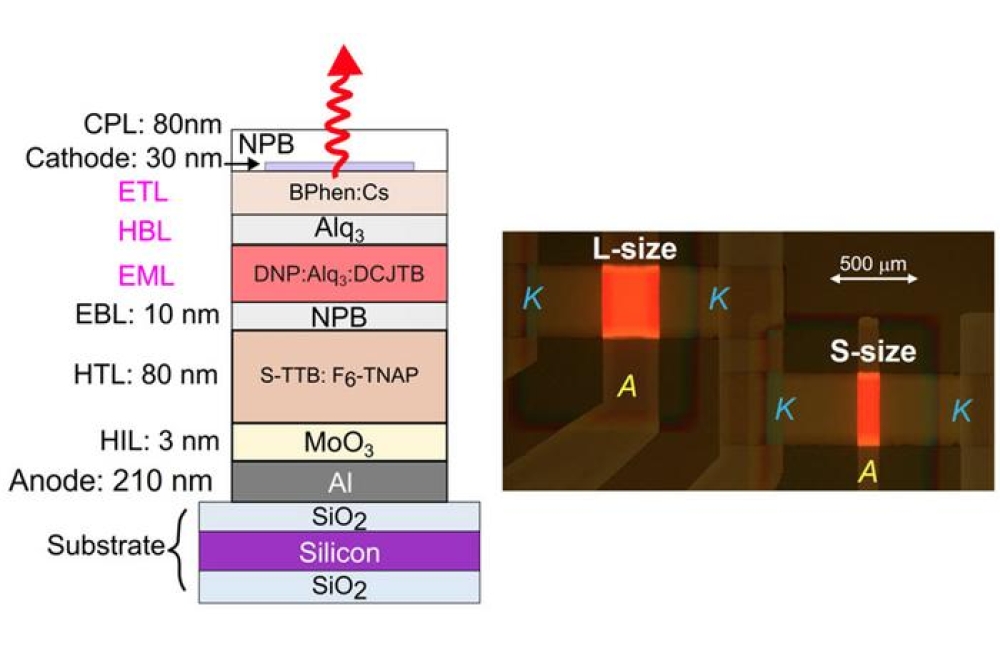
A recent study from scientists at the University of St Andrews and the University of Cambridge in the UK, published in Advanced Photonics, shows that OLEDs can be engineered to transmit data at record-breaking speeds over surprisingly long distances—potentially transforming how we connect devices in the future.
Visible light communication (VLC), sometimes called Li-Fi, uses light instead of radio waves to transmit data. It offers advantages like high bandwidth, low interference, and the ability to integrate with existing lighting systems. OLEDs are especially attractive for VLC because they’re thin, flexible, and easy to manufacture. But until now, they’ve been considered too slow for high-speed data transmission.
This new research 'High-speed organic light-emitting diodes based on dinaphthylperylene achieving 4-Gbps communication,' challenges that assumption.
By carefully selecting materials and optimising the design of OLEDs, the team achieved data transmission rates of up to 4.0 gigabits per second (Gbps) over a 2-meter distance and 2.9 Gbps over 10 meters—both records for OLED-based systems. For comparison, previous OLED systems topped out at around 2.85 Gbps, and only over very short distances.
The key to this record-breaking advance lies in the use of a stable organic compound called dinaphthylperylene (DNP), known for its long operational lifetime and fast light emission. The team built OLEDs using DNP and fine-tuned the thickness and composition of each layer in the device to balance brightness and speed. They also experimented with different device sizes, finding that larger OLEDs could emit more light without sacrificing speed, which helped maintain strong signals over longer distances.
To test performance, the team set up a VLC system using these OLEDs as transmitters and high-speed photodiodes as receivers. They used a modulation technique called orthogonal frequency division multiplexing (OFDM), commonly used in Wi-Fi and 5G, to maximize data throughput. The system was able to maintain low error rates even at high speeds, thanks in part to advanced signal processing and error correction.
An impressive aspect of the study is the 10 m data link. Achieving nearly 3 Gbps over this distance with a single OLED transmitter is a major leap forward, especially considering that most previous OLED-based systems operated over less than half a meter. This opens the door to practical applications of OLED VLC in homes, offices, and even wearable devices.
The researchers note that enhancing OLED material stability, increasing light output, and refining device architecture could push data rates even higher. As OLED technology continues to evolve in response to display and lighting industries, it will doubtless contribute to the future of wireless communication.
Reference
K. Yoshida et al., Adv. Photon. 7(3), 036005 (2025)