
Chris Van de Walle receives Welker Award
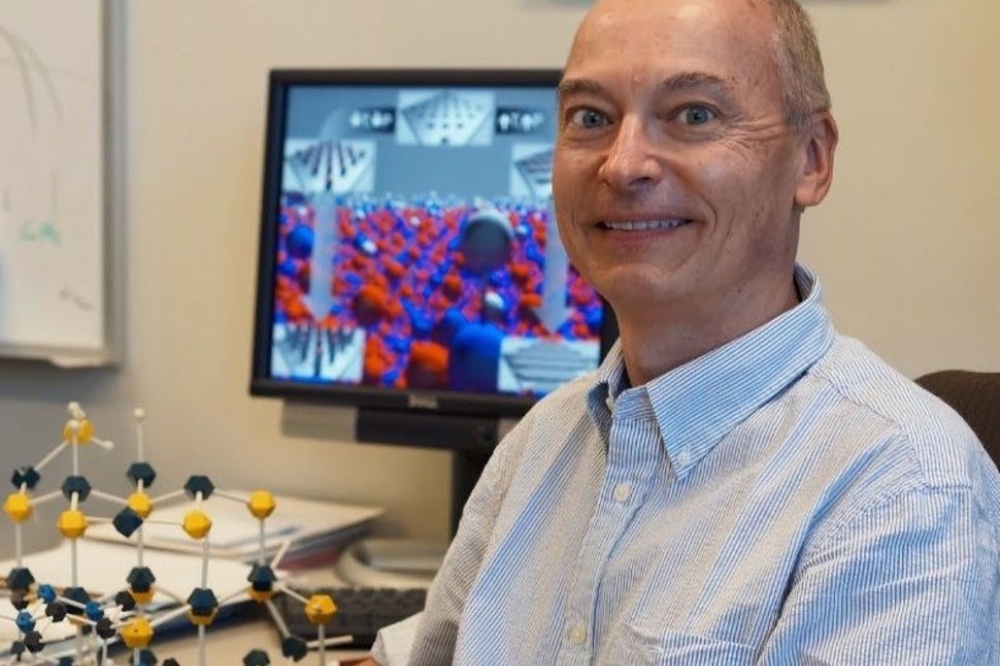
Chris Van de Walle of UC Santa Barbara’s Materials Department has received the 2025 Heinrich Welker Award in recognition of his “development and application of computational methods to elucidate the properties of interfaces, defects, doping, polarisation, and loss mechanisms in compound semiconductors.”
Established in 1976 by Siemens and named after a German physicist*, the Welker Award recognises outstanding research in the area of III-V compound semiconductors.
Past awardees include many luminaries in the field of semiconductors, including UCSB Nobel Laureate Herbert Kroemer, Dean of Engineering Umesh Mishra, and laser expert Larry Coldren.
“This is such a well-deserved honor and recognition for Chris Van de Walle,” said Mishra. “For decades, he has contributed one significant finding after another, repeatedly contributing new understanding of key fundamental phenomena that affect performance of compound semiconductors, especially in the area of LED efficiency. His theoretical investigations are reflected in any number of advanced electronic technologies that are taken for granted today but have been enabled by his research. We in the College of Engineering offer Chris our most sincere congratulations on this latest achievement.”
Van de Walle accepted the award at a ceremony in Banff, Canada, in conjunction with the 51st International Symposium on Compound Semiconductors (ISCS) and the 36th International Conference on Indium Phosphide and Related Materials (IPRM).
His achievements in computational physics and materials have previously been recognised with the Materials Theory Award from the Materials Research Society (MRS) and the Aneesur Rahman Prize for Computational Physics from the American Physical Society (APS). The Welker Award provides recognises Van de Walle’s impact on materials technology.
“It's a tremendous honour for me to receive this award,” Van de Walle said. “My work is fundamental in nature, and while I have always put great emphasis on making connections to actual materials and real-world applications, it wasn’t evident that this impact would be readily recogniSed. Receiving the Welker Award provides a wonderful confirmation that my efforts, enabled by many great students and postdocs, have been fruitful.”
Early in his career, Van de Walle developed a model that is still widely used for predicting heterojunction band offsets. In the 1990s he started making seminal contributions to the understanding of doping and defects in electronic materials. He challenged conventional wisdom by showing that impurities, rather than native defects, were responsible for unintentional doping of wide-bandgap semiconductors such as GaN and zinc oxide.
He subsequently addressed causes of efficiency loss in light emitters by developing accurate methods for calculating Auger-Meitner and Shockley-Read-Hall recombination. He has also been applying these techniques to understand and predict spin qubits and single-photon emitters for quantum information science.
Van de Walle is a fellow of MRS, APS, the Institute of Electrical and Electronics Engineers, the American Vacuum Society (AVS), and the American Society for the Advancement of Science.
* Heinrich Johann Welker (1912 - 1981 in Erlangen) was a German theoretical and applied physicist who invented the 'transistron', a transistor made at Westinghouse independently of the first successful transistor made at Bell Laboratories. He did fundamental work in III-V compound semiconductors, and paved the way for microwave semiconductor elements and laser diodes. Source: Wikipedia