
Beyond disinfection: Unlocking the full potential of the UV LED
Advances in LED technology across the UVA, UVB, and UVC bands are opening transformative opportunities in manufacturing, sensing, healthcare, and beyond.
BY PRATIBHA SHARMA AND SAYA HAN FROM VIOLUMAS
During the last decade, and fuelled by the Covid-19 pandemic, UVC LEDs have become synonymous with the disinfection of air, water, and surfaces. These solid-state sources, which are renowned for being compact, mercury-free and instantly switchable, have garnered a great deal of attention in public healthcare, spurring a surge in new product development.
However, since the height of the pandemic, the initial enthusiasm in the UV LED has waned. This has led makers of these devices to start targeting more mature and purposeful applications, and foster a long-term vision that’s based on replacing mercury lamps and new product development. Due to their flexible form factor, narrow spectral width and high reliability, UV LEDs are now compelling candidates for many applications, and are currently being deployed in a number of fields, including spectroscopy, environmental monitoring and medical devices.
Since the late 1800s, it’s been well established that UV light offers health benefits, by killing bacteria and viruses. UV lamps based on mercury vapour were launched in the 1930s, and since then they have been used for a variety of tasks, from water purification to curing. But these mercury-based lamps are far from ideal, with significant limitations that include bulky form factors, hazardous materials, limited spectral control, and long warm-up times. Due to these weaknesses, they are unsuitable for many demanding industries.
The introduction of UV LEDs has opened new doors, with this promising alternative enabling more flexible designs. Initially, these emitters struggled to match the optical performance of mercury lamps, falling short in output power and lifetime, particularly for shorter wavelengths. But with significant advances in epitaxy, packaging, and thermal management, UV LEDs are now hitting performance levels once considered unattainable.
A key strength of the UV LED over the mercury lamp is that its emission profile can be tailored to a particular application. For tasks such as curing and 3D printing, mercury lamps were once the source of choice – but in order to realise sufficient spectral purity, they must be combined with expensive filters. What’s more, as lamps have long warm-up times, they have to be left on, leading to excessive energy consumption. Turning to UV LEDs addresses these drawbacks, while enabling faster production cycles, reduced thermal budgets, the elimination of start-up times and delivery of uniform exposure. Moreover, controlling the LED at the chip level allows dosage to be precisely managed, enabling consistent curing. Alongside these strengths, UV LEDs have flexible form factors that ease integration, making these sources the global standard for curing adhesives, coatings, and inks.
One area where the development of high-power 265 nm and 255 nm UV LEDs is opening new possibilities is semiconductor manufacturing and inspection equipment. Examples of the uses of these devices include surface decontamination in cleanroom environments, wafer edge cleaning, and lithography-related processes benefitting from precise, localised UV exposure.
In the photovoltaic industry, UV LEDs are also being used for numerous applications. They include deployment in spectrum-tailored applications, such as designing solar simulators to emulate the solar spectrum. UV LEDs are also being used for solar panel inspection, to detect contamination.
Yet another application for today’s UV LEDs are as the key light sources in absorption and fluorescence spectroscopy systems. These sources are helping to detect pollutants such as ozone, sulphur dioxide, aromatics, and many other organic compounds, with precision and scalability. Here, the motivation behind the steady replacement of mercury lamps with UV LEDs is not limited to environmental concerns, but extends to the merits of superior control, stability, and operational efficiency. Note that thanks to a lower cost-of-ownership, UV LEDs are increasingly explored as viable alternatives to UV lasers as well.
In addition to all these industrial applications, UV LEDs are being deployed in various medical applications that are not associated with disinfection. Narrowband UVB LEDs are being used to treat skin conditions, such as psoriasis and vitiligo, offering safer and more portable alternatives to conventional phototherapy equipment; and those emitting in the UVA are enabling progress in photodynamic therapy, where light-activated drugs selectively target tissues.
In terms of longevity, the UVC LED has improved a great deal over the past decade. What was once a major limitation is no more, with typical lifetimes now 10,000 to 20,000 hours, which is acceptable for many of today’s applications. And further gains on this front, under real-world conditions, are to be expected, given the continued advances in material quality, chip design, and packaging. Devices are also expected to benefit from advanced thermal management technologies that will improve performance.
Helping to increase the competitiveness of UV LEDs is a reduction in their price. That for UVA LEDs has dropped substantially with volume production, and prices for UVB and UVC LEDs are continuing to fall, encouraging early adoption. As manufacturing techniques mature and production yields improve, the trend of a fall in the cost-per-milliwatt should continue.
During the initial adoption phase of UV LEDs, many will overlook the importance of system integration – but it is a key consideration. To produce the best possible UV systems, they have to be holistically designed to optimise optical distribution, manage thermal budgets, and ensure reliability. Additional factors are that materials exposed to deep-UV must be long-lasting, and appropriate shielding or interlocks must be incorporated to protect users. In this regard, the companies that are offering complete, ready-to-integrate UV LED solutions – including optics, drivers, thermal management, and safety features – will have a distinct advantage as adoption continues to grow.
Given the progress of the UV LED over the past five years, it is clear that we are now approaching a critical inflection point. Disinfection provided the catalyst that introduced UV LEDs to a broad market, but their future adoption extends much further. While the pandemic drove a surge in consumer products based on the UV LED, adoption of these sources has evolved as they start to serve in more long-term solutions targeting healthcare environments, such as mobile units and surgical rooms.
In the coming decade, UV LEDs are on course to drive innovations in high-precision manufacturing, real-time environmental monitoring, next-generation medical therapies, and scientific research. Their capability to deliver targeted, efficient, and sustainable optical power aligns perfectly with the global push for smarter, greener technologies. Thanks to the current AI boom, UV LEDs are destined to work hand-in-hand with machine learning technologies to drive development of smart systems. For example, AI-enabled systems could dynamically control UV LED arrays to fine-tune curing processes in advanced manufacturing, optimise UV dosage in real-time water monitoring, and personalise phototherapy treatments, based-on patient data. As materials science, photonics, and data science converge, UV LEDs are poised to become not just components, but core enablers of intelligent, responsive systems across multiple sectors.
At Violumas, a producer of UV LEDs, we are excited about the role that these sources can play in reshaping industries and enabling solutions once considered out of reach. Through continued innovation, collaboration, and investment, UV LEDs are poised not merely to illuminate the future, but transform it.
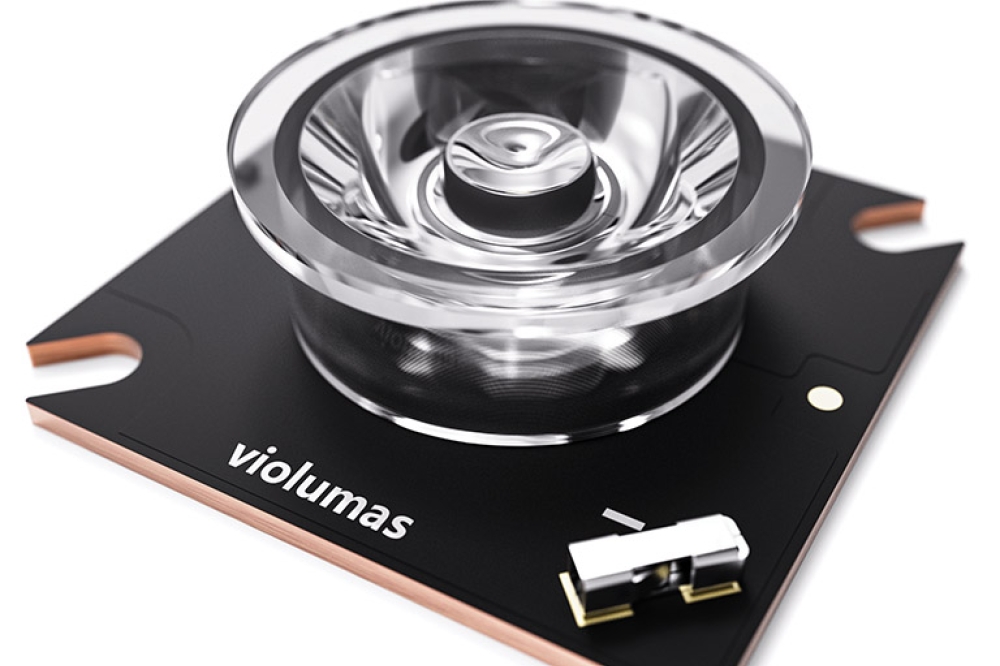
Main image: VioBeam Ultra-Narrow Beam UV LED module with integrated optics for focused 10 ° beam, designed for precision industrial applications