
UK team announces laser breakthrough
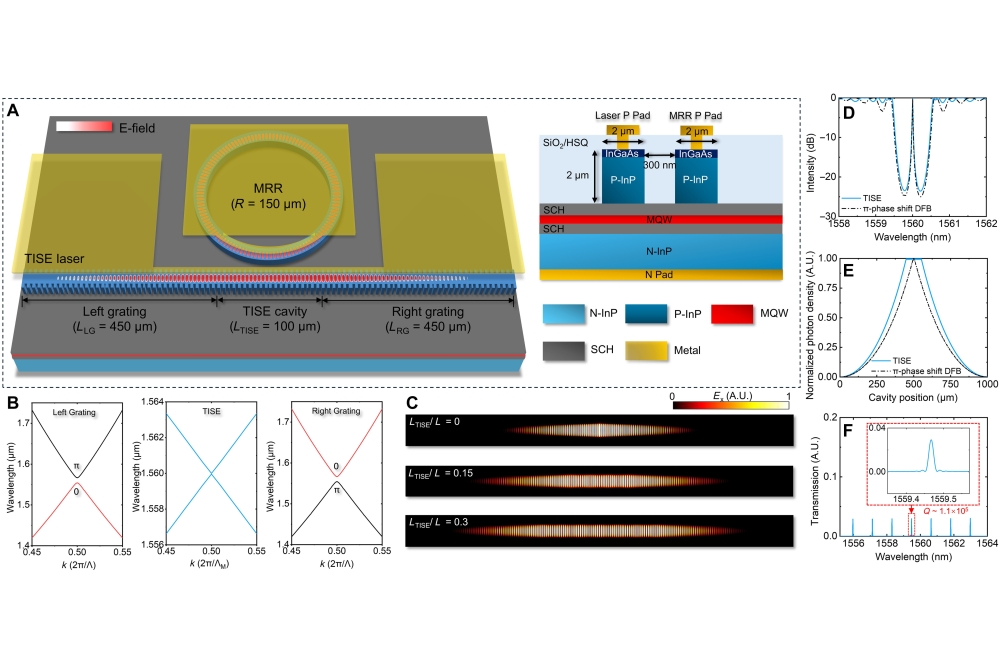
Researchers from the University of Glasgow have designed and built a narrow-linewidth laser on a single, fully integrated microchip that achieves the best performance ever recorded in semiconductor lasers of its type.
The team’s paper, titled ‘Narrow-linewidth monolithic topological interface state extended laser with optical injection locking’, is published in Science Advances.
The new system, which they call a ‘topological interface state extended laser with optical injection locking’, or MOIL-TISE, is claimed to be able to produce a narrower, purer laser light than any previous distributed feedback (DFB) laser system. At just 983Hz, this is a significant advance on monolithic DFB lasers currently on the market, which operate at the MHz range.
The InP device was built at the University of Glasgow’s James Watt Nanofabrication Centre.
Previous high spectral purity lasers faced a major challenge: balancing top-level performance with compact design. To achieve efficiency, designers often relied on hybrid integration and bulky external components, which limited their practicality and restricted their potential in on-chip integrated applications.
The system’s performance is enabled by a uniquely-shaped design, which breaks the chip into three regions, each with their own optical phase, specifically tuned to keep the light evenly distributed between them. Combined with a micro-ring resonator integrated into the chip, the system can internally recycle light to stabilise its performance and enable the system’s tightly-focused linewidth.
The development of the MOIL-TISE system was supported by the University’s Critical Technologies Accelerator (CTA). The CTA is funded through a share of the Glasgow City Region’s Innovation Accelerator fund and aims to develop cutting-edge nano-scale technologies for a range of applications.
The CTA’s Xiao Sun is the paper’s first and corresponding author. He said: “The University of Glasgow is unique in the UK in that it’s possible to take a project like this from an initial idea to a fully-featured prototype without leaving our campus. The James Watt Nanofabrication Centre enabled us to design, fabricate and test our MOIL-TISE system, dramatically accelerating the research process.
Lianping Hou of the James Watt School of Engineering is the paper’s co-corresponding author. He said: “Our MOIL-TISE laser makes three significant breakthroughs and improvements in this field. It’s the first monolithic device of its kind, with every component integrated on a single chip. It can create a laser with remarkable frequency purity, the highest ever achieved in a monolithic distributed feedback laser of this kind. It is also capable of easily switching between optical phases, a property required in the quantum key distribution systems which will underpin the unbreakable encryption and communication devices of the future.”
Pictured above: (A) Structure and electrical field distribution of the MOIL-TISE laser. (B) Calculated band diagram band structures of the left grating, TISE grating, and right grating. (C) Normalised electric field distributions for LTISE/L = 0, 0.15, and 0.3. (D) Transmission spectrum and (E) normalised photon distribution in the TISE laser compared to the conventional π-phase shift DFB laser. (F) Transmission spectrum from the TISE laser to MRR.