
A new material for next-gen LEDs and solar cells?
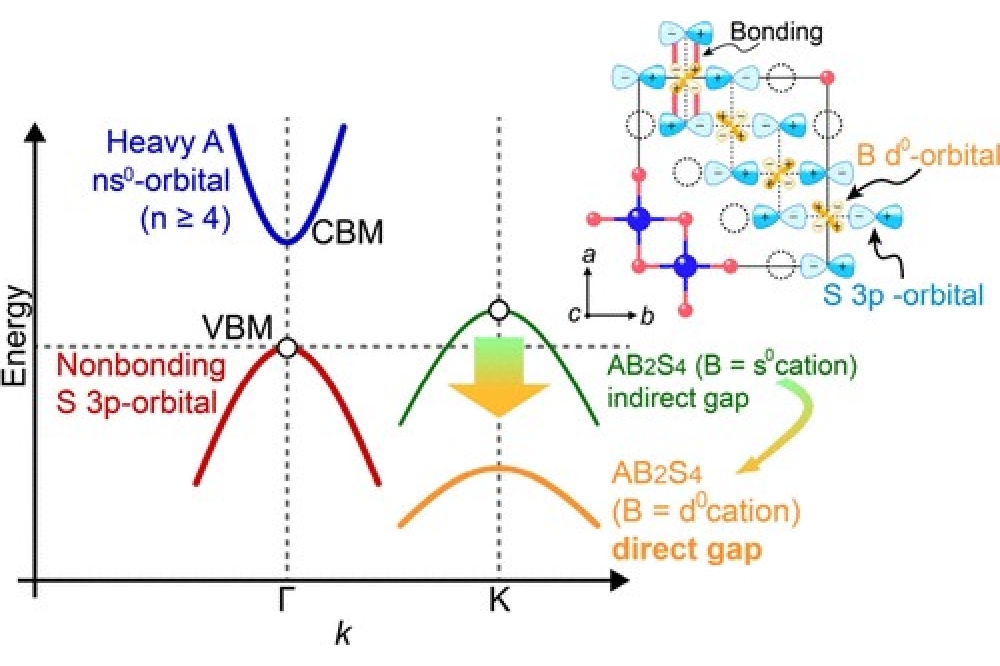
Researchers at the Institute of Science Tokyo have reported on a semiconductor (Zn,Mg)Sc2S4, previously overlooked for optoelectronic use, that can be tuned to switch between n-type and p-type conduction, leading to future pn homojunction devices.
They think his spinel-type sulphide semiconductor could offer a practical path toward the development of more efficient LEDs and solar cells.
The findings were published in the Journal of the American Chemical Society on September 17, 2025.
LEDs, solar cells, and semiconductor lasers rely on pn junctions for their operation. At the junction, electrons and holes either recombine to produce light, as in LEDs, or are separated to generate current, as in solar cells. The efficiency depends on the material. For instance, GaAs recombines carriers efficiently and emits light, making it ideal for LEDs, while silicon excels at capturing sunlight and generating current but is a poor light emitter.
The research team was led by Hidenori Hiramatsu and Kota Hanzawa of the Materials and Structures Laboratory, Science Tokyo, Japan, together with Hideo Hosono of the MDX Research Center for Element Strategy.
Hiramatsu focuses on the 'green gap' problem, a long-standing limitation in LEDs, where materials such as InGaN and AlGaInP lose efficiency in the green region. “Our semiconductor material is suitable for both green emission and photovoltaic applications,” he says, offering a promising path for next-generation LEDs and solar cells.
Undoped ZnSc2S4 produced a strong orange emission at room temperature. When magnesium was introduced in place of zinc, the emission could be shifted from orange to green and even to blue, depending on the degree of substitution. The team also demonstrated that by introducing small amounts of titanium at the Sc3+ site, or by slightly reducing the zinc content, the material could be switched to n-type or p-type conduction, respectively.
This chemical flexibility allowed the conductivity to be modulated over nine orders of magnitude, from the insulating state of undoped ZnSc2S4 (2.5 × 10⁻¹¹ S/cm) to semiconducting levels in ZnSc1.84Ti0.16S4 (3.7 × 10⁻⁵ S/cm) and Zn0.9Sc2S4 (1.8 × 10⁻² S/cm), enabling its use both as an absorption layer in solar cells and as a green-emission layer in LEDs.
“The sulphide semiconductor identified in this study meets the requirements for both highly efficient light absorbers in solar cells and green light emitters in LEDs, making it a strong candidate for next-generation optoelectronic devices,” says Hiramatsu.
Reference
Kota Hanzawa et al; Journal of the American Chemical Society (2025)