
Tokyo team makes blue OLED breakthrough
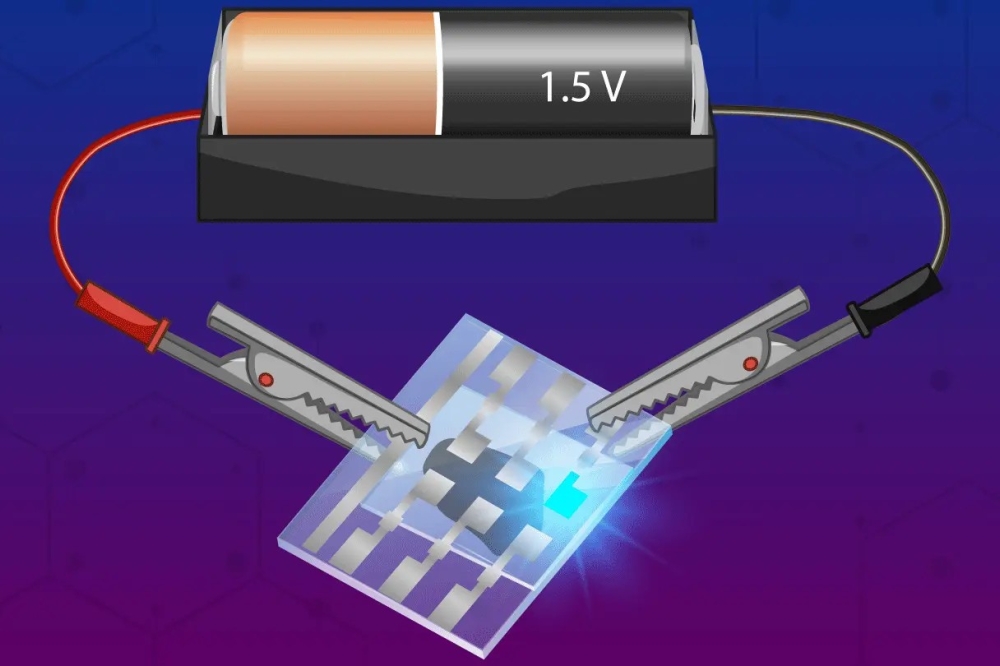
A deep blue organic light-emitting diode (OLED) developed by researchers at Science Tokyo operates on just a single 1.5V, overcoming the high-voltage and colour-purity problems that have long limited blue OLEDs. The study was published online in the journal Advanced Optical Materials on September 30, 2025.
The breakthrough, by a research team led by Seiichiro Izawa of the Materials and Structures Laboratory at Science Tokyo, was achieved by introducing a new molecular dopant that prevents charge trapping, a problem that previously hampered the performance of low-voltage OLEDs.
The resulting device produces sharp blue emission that meets BT.2020 standards, paving the way toward brighter, more energy-efficient displays.
OLEDs are widely used in large-screen TVs and smartphone displays. Yet, among the three primary colours needed for full-colour technology—red, green, and blue—the blue emitters remain the most challenging. They demand higher energy, often requiring driving voltages above 3V, and suffer from limited long-term stability.
The research team's breakthrough is based on upconversion-type OLEDs (UC-OLEDs), which generate light through triplet–triplet annihilation (TTA). In conventional OLEDs, light is produced when electrons and holes meet in the emission layer, forming a charge-transfer state that excites a fluorescent dopant. UC-OLEDs reduce the operating voltage by shifting this process: electrons and holes form a charge-transfer state at the interface between the hole transport layer and the electron transport layer. This energy is then transferred to triplet excitons in the host material. When two triplets annihilate, they create a higher-energy singlet state. That singlet then excites a dopant molecule, which emits light.
However, earlier versions of UC-OLEDs struggled with colour purity. They often produced sky-blue light with a broad spectrum. The problem stemmed from the choice of dopant and its tendency to trap holes. In UC-OLEDs, there are no free electrons available to neutralise these trapped charges. As a result, trapped holes accumulate, reducing the mobility of other holes and preventing efficient recombination.
To overcome this, the team tested a range of blue-emitting dopants. They began with the DABNA family of materials, known for their narrow emission. In practice, however, these dopants slowed down charge movement and raised the operating voltage by 1 to 2 V. This occurred because DABNA has a higher highest occupied molecular orbital (HOMO) level (the energy level for holes) than the host material, causing the molecules to act as traps that block hole transport. However, they noticed that when the traps were shallow enough, trapped holes could escape via thermal energy.
Building on this insight, the researchers introduced a new class of dopants: the QAO family. QAO, short for quinolinoacridine-dione, belongs to a group of multi-resonance thermally activated delayed fluorescence molecules. Importantly, their HOMO levels are lower than those of the host materials, which prevents them from trapping holes and ensures smooth charge transport.
Within this family, one material proved especially promising: tB-CZ2CO, a QAO derivative with bulky tert-butyl side groups. Devices containing only 0.5 percent of this material produced sharp, deep blue emission at 447 nm with a narrow bandwidth of 20 nm, meeting the demanding BT.2020 colour standard for wide-gamut displays.
By analysing how the molecular structure and electronic properties of dopants affect charge transport and trap formation, the researchers established clear design rules for selecting dopants that produce narrowband blue emission. “Overall, our findings not only elucidate the complex doping mechanisms in UC-OLEDs but also establish a rational framework for designing energy-efficient, high-colour-purity blue UC-OLEDs with broad implications for next-generation optoelectronic applications,” says Izawa.
The team says this work paves the way toward sharper, more energy-efficient displays with lower power consumption in large-screen televisions, smartphone displays, and other OLED-based technologies.
Reference
Qing-Jun Shui et al: Advanced Optical Materials (2025)