
News Article
Chinese team develops effective buffer for perovskite cells
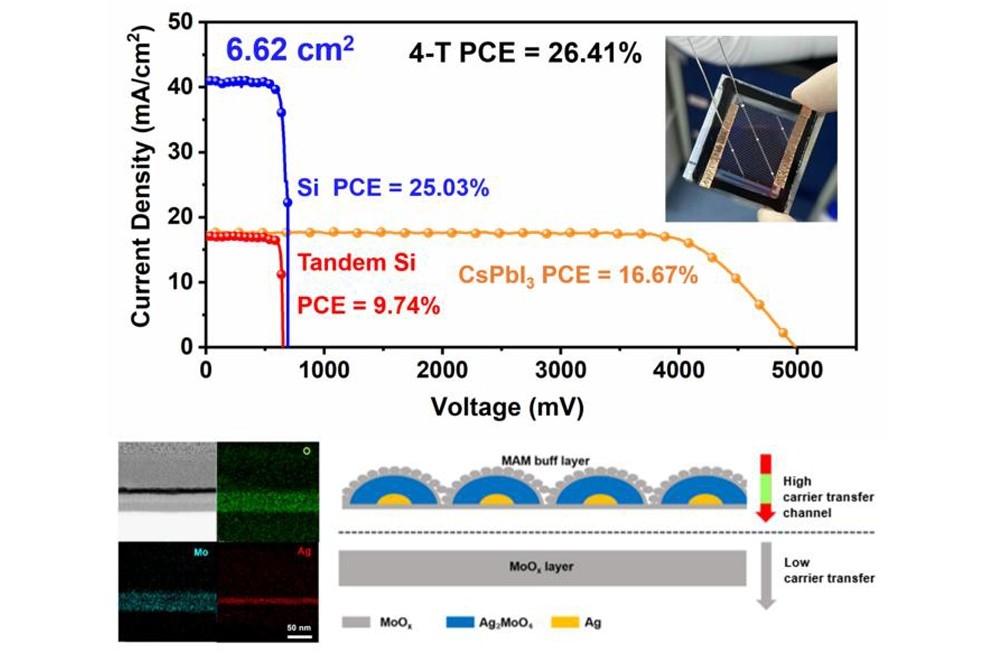
'Sandwiched' MoOx/Ag/MoOx buffer layer improves performance and scalability CsPbI3/TOPCon tandem solar cells
A collaborative research team led by the Institute of Physics at the Chinese Academy of Sciences has developed a new 'sandwiched' MoOx/Ag/MoOx (MAM) buffer layer to improve the performance and scalability of semi-transparent all-inorganic perovskite CsPbI3/TOPCon tandem solar cells. The results were published in Materials Futures.
One critical bottleneck this work addresses is the damage caused by magnetron sputtering during deposition of transparent conductive oxides onto charge transport layers. Traditional buffer layers like MoOₓ offer limited protection and often suffer from poor charge transport, parasitic absorption, and fabrication challenges at large scales.
The team found that the MAM buffer layer enhances light transmittance and charge carrier transport while effectively protecting underlying layers from sputtering damage, suggesting this kind if layer could pave the way for next-generation, high-efficiency perovskite-based photovoltaic systems.
The innovation enabled semi-transparent CsPbI₃ solar cells to achieve a power conversion efficiency (PCE) of 18.86 percent (0.50 cm²) and corresponding 4-T CsPbI₃/TOPCon tandem cells to reach 26.55 percent PCE.
The technology was also successfully scaled to larger-area minimodules, achieving 16.67 percent and 26.41 percent PCE for CsPbI₃ and 4-T tandem minimodules (6.62 cm²), respectively—marking the first reported minimodule demonstration for this architecture.
Future research will explore more suitable transparent and excellent photostability materials to directly draw the two devices together in series, especially for large-size tandem modules by considering more practical application scenarios while controlling costs.
Reference
Rui Zhang et al; Mater. Futures 4 (2025)