
Cavity control boosts performance of blue VCSEL lasers
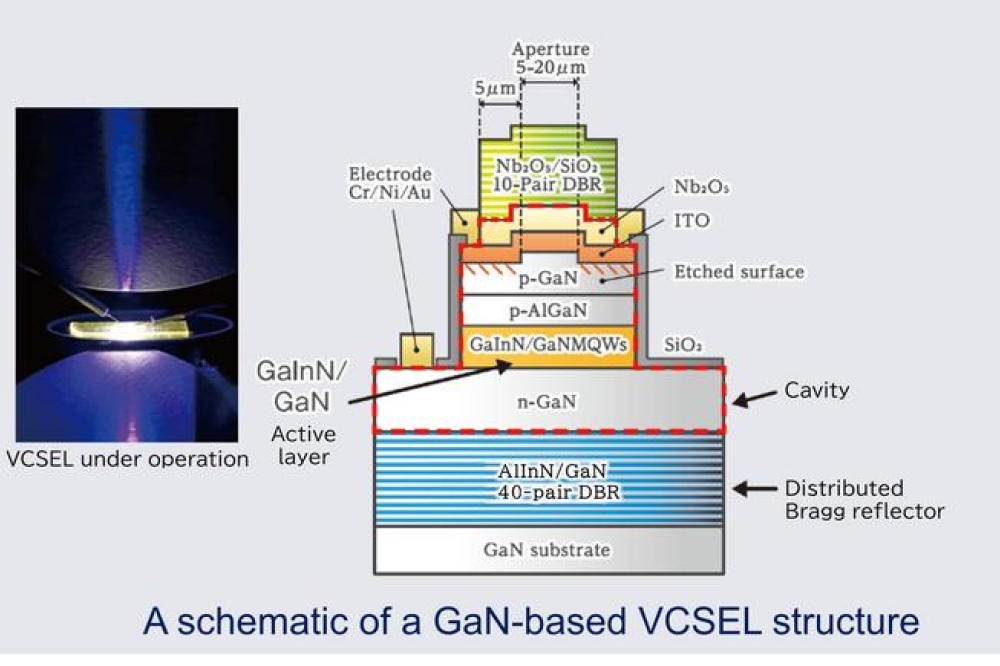
GaN-based VCSELs are promising for displays, sensing, and optical communication, but improving efficiency remains challenging. Now a research team led by Tetsuya Takeuchi, Satoshi Kamiyama, and Motoaki Iwaya, all professors at the department of materials science and engineering at Meijo University, Japan have shown that 'cavity tuning' which controls resonance wavelength, strongly affects laser performance.
By analysing variations across a VCSEL wafer, the team identified optimal mirror loss conditions and extracted device parameters. Their approach achieved 26.4 percent wall plug efficiency, offering guidance for next-generation high-efficiency visible-light semiconductor lasers.
Conventional studies have mainly focused on gain tuning, also known as detuning. But in this case the researchers demonstrated that resonance wavelength alignment relative to the distributed Bragg reflector centre wavelength critically affects laser operation. Their research was published in Volume 128, Issue 17 of Applied Physics Letters on April 27, 2026.
The researchers studied GaN-based VCSEL wafers containing AlInN/GaN distributed Bragg reflectors, which possess a relatively narrow optical stop band. Because of this narrow range, even small shifts in resonance wavelength can significantly change mirror loss and influence laser efficiency.
By examining in-plane variations across the wafer, the team observed how cavity tuning systematically altered mirror loss values from 25 to 50 cm−1. They then correlated these changes with important laser characteristics, including differential external quantum efficiency, threshold current density, and wall-plug efficiency.
Their measurements showed that cavity tuning provided valuable insight into internal device physics that conventional detuning analysis alone could not explain. By analysing the mirror loss dependence, the team extracted key internal parameters, including an injection efficiency of approximately 85 percent and an internal loss near 11 cm−1. Importantly, they identified an optimal mirror loss region around 35–40 cm−1, where wall-plug efficiencies above 25 percent could be achieved. The best-performing device demonstrated a wall-plug efficiency of 26.4 percent, exceeding the group’s previously reported performance.
“What motivated this study was our observation of in-plane variations in laser characteristics,” explained Takeuchi. “By measuring devices across the wafer and analyzing the data, we found that conventional gain detuning alone could not fully explain the results. This led us to identify the importance of cavity tuning.”
The findings could help accelerate the development of practical high-efficiency visible-light laser sources. Since GaN-based VCSELs are considered promising for compact photonic systems, the improved understanding of cavity tuning may support more reliable design strategies for commercial devices requiring high optical performance and energy efficiency.
“The observation of wall-plug efficiency exceeding 20 percent, which was among the highest levels reported worldwide at the time, strongly encouraged me to further advance my research on VCSEL characteristics,” said Naoki Shibahara, first author and graduate student at Meijo University's graduate school of science and technology. He is currently investigating 2D VCSEL integration for high-power operation, focusing on device interactions, thermal and optical effects, and highly efficient array design.
Overall, the study demonstrates that cavity tuning is a critical design parameter in GaN-based VCSELs alongside conventional gain tuning. By transforming natural in-plane wafer variations into a research advantage, the team established a practical method for optimizing mirror loss and improving laser efficiency. The findings provide important guidance for the future design of high-performance semiconductor lasers for sensing, communication, and advanced photonic technologies.