
Perovskites show promise for quantum systems
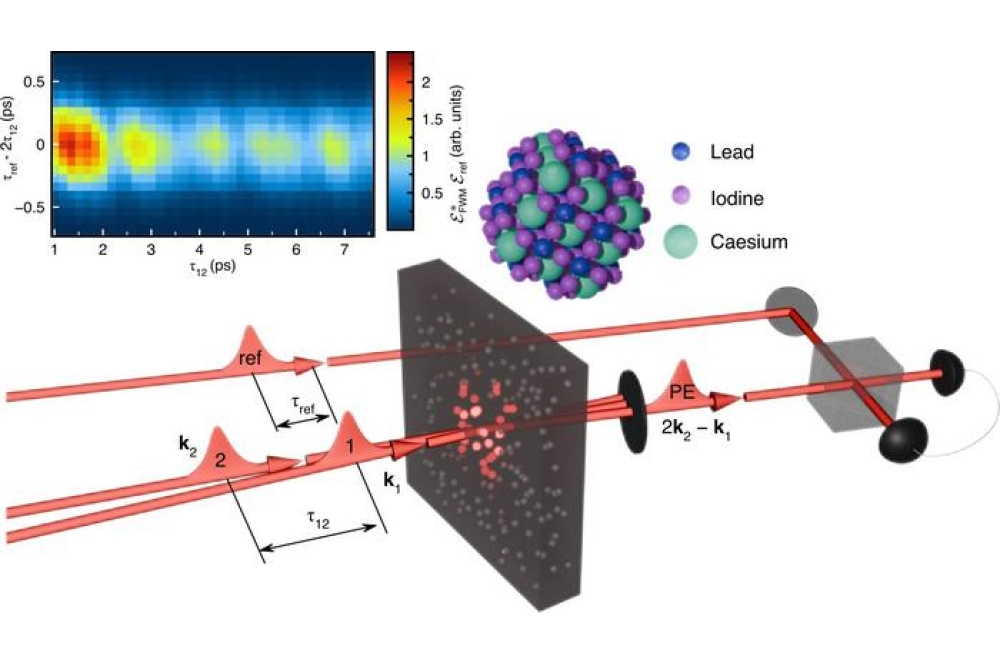
An international team of researchers has reported a major advance in understanding quantum dynamics in semiconductor materials. They directly observed how excitons and phonons evolve together in perovskite nanocrystals, revealing a coherent quantum dance between light-induced electronic excitations and crystal lattice vibrations.
They published their findings on the 26th May 2026 in the paper 'Quantum beats of exciton-polarons in CsPbI3 perovskite nanocrystals' in Nature Communications.
An exciton is created when light excites an electron inside a semiconductor. The electron absorbs energy and leaves behind a positively charged 'hole'; the two bind together and move through the crystal as a single quantum object. A phonon is a quantum of crystal lattice vibration.
These fundamentally different objects appear to be strongly linked in perovskites and evolve together as a coupled quantum system. Perovskite nanocrystals form a nanoscale 'box' that traps both excitons and phonons, making the interaction especially strong. When an exciton is created by a short laser pulse, it also slightly distorts the surrounding crystal lattice, creating phonons. The electronic excitation and the lattice vibration then form the joint quantum state known as an exciton-polaron.
In most solids, the interaction with the crystal lattice quickly destroys the fragile quantum states. However, the researchers found a striking exception in lead-halide perovskite nanocrystals. At low temperature of 2 Kelvin, the crystal vibrations remain well defined, allowing the quantum state to evolve coherently for about 10 picoseconds, corresponding to many oscillations and thus many turns of the quantum 'dance'.
Using very short laser pulses lasting for about hundred femtoseconds, the experimental team from TU Dortmund University directly tracked this evolution and observed pronounced quantum beats. These beats appear when a system exists in a coherent superposition of different quantum states at the same time.
Since each state evolves with a slightly different energy, their quantum waves interfere with each other. This interference produces a rhythmic oscillation, a quantum beat (rather as in music). In the examined nanocrystals, these oscillations revealed how excitons and crystal vibrations exchange energy and evolve together on ultrafast timescales.
What makes the result especially remarkable, according to the team, is the exceptionally strong amplitude of quantum beats and their long coherence. In close collaboration with theory teams from Condensed Matter Theory at TU Dortmund University and Jackson State University in the USA, the researchers demonstrated that the effect can be tuned simply by changing the nanocrystal size: Excitons in smaller nanocrystals couple stronger to lattice vibrations, while in larger ones the oscillations are preserved for longer times. This opens a practical way to engineer and control the quantum dynamics of this system.
The team says these findings identify perovskite nanocrystals as a promising platform for future quantum devices. The ability to control coherent exciton-phonon dynamics could enable new approaches for semiconductor quantum information processing, quantum light sources, and the generation of single phonons - individual packets of crystal vibration. More broadly, the work shows that crystal vibrations, often viewed as a source of decoherence, can instead become a useful quantum resource.