
CEA-Leti makes colour microLED breakthrough
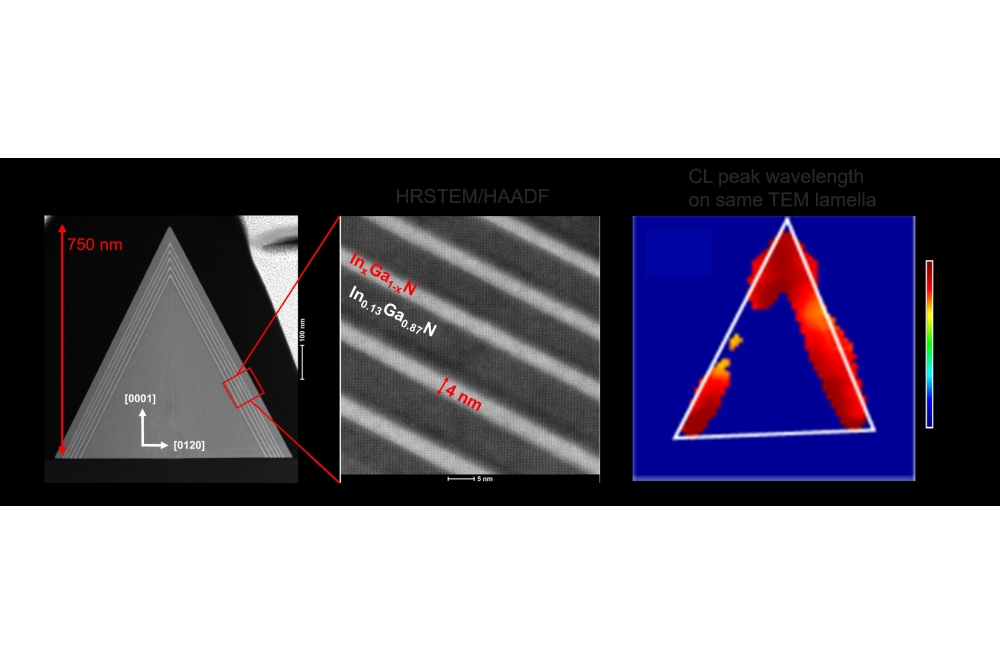
CEA-Leti and the Centre for Research on Heteroepitaxy and its Applications (CRHEA) have announced R&D results that have cleared a path toward full-colour microdisplays based on a single material system, a long-standing goal for augmented and virtual reality (AR/VR) technologies.
The project, presented in a paper published in Nature Communications Materials, developed a technique for growing high-quality InGaN-based quantum wells on sub-micron nanopyramids, enabling native emission of red, green, and blue (RGB) light from a single material system.
Titled 'Regular Red-Green-Blue InGaN Quantum Wells With In Content Up To 40% Grown on InGaN Nanopyramids', the paper will be presented at the MicroLED Connect Conference on Sept. 24, in Eindhoven, the Netherlands.
Microdisplays for immersive devices require bright RGB sub-pixels smaller than 10 × 10 microns. According to the paper, “the use of III-nitride materials promises high efficiency micro-LEDs compared to their organic counterparts. However, for such a pixel size, the pick and place process is no longer suitable for combining blue and green micro-LEDs from III-nitrides and red micro-LEDs from phosphide materials on the same platform.”
Red-emitting phosphide micro-LEDs also suffer from efficiency losses at small sizes, while colour conversion methods face challenges in deposition precision and stability.
The team grew InGaN nanopyramids using MOVPE with an epitaxial graphene layer on SiC serving as a selective mask.
“Using these nanostructures relieved the internal strain that usually limits indium incorporation,” said lead author Amélie Dussaigne of CEA-Leti. “As a result, we achieved record InN mole fractions of 40 percent in the quantum wells—high enough to generate red light reliably without degrading crystal quality.”
“This new technology addresses one of the most difficult bottlenecks in display miniaturisation,” said Adrien Michon, a research scientist in the project with the CRHEA. “It opens the door to manufacturing full-color microdisplays with unmatched brightness and resolution—critical for next-generation AR and VR.”
Implications for AR/VR Displays
This breakthrough enables native RGB emission from a single material system, simplifying integration and improving performance in future microdisplays. Because the nanopyramid structures can be patterned at sub-micron scale, they are well suited for the <10 micron pixel pitch demanded by AR/VR headsets, smart glasses, and other immersive devices. In the longer term, full color micro-display for AR/VR, fast optical communications (emission + reception), and beyond that: photovoltaic applications, renewable hydrogen production.
CRHEA is a French National Centre for Scientific Research (CNRS) and Université Côte d’Azur research laboratory specialising in the study of materials.