
Antimony addition advances the APD
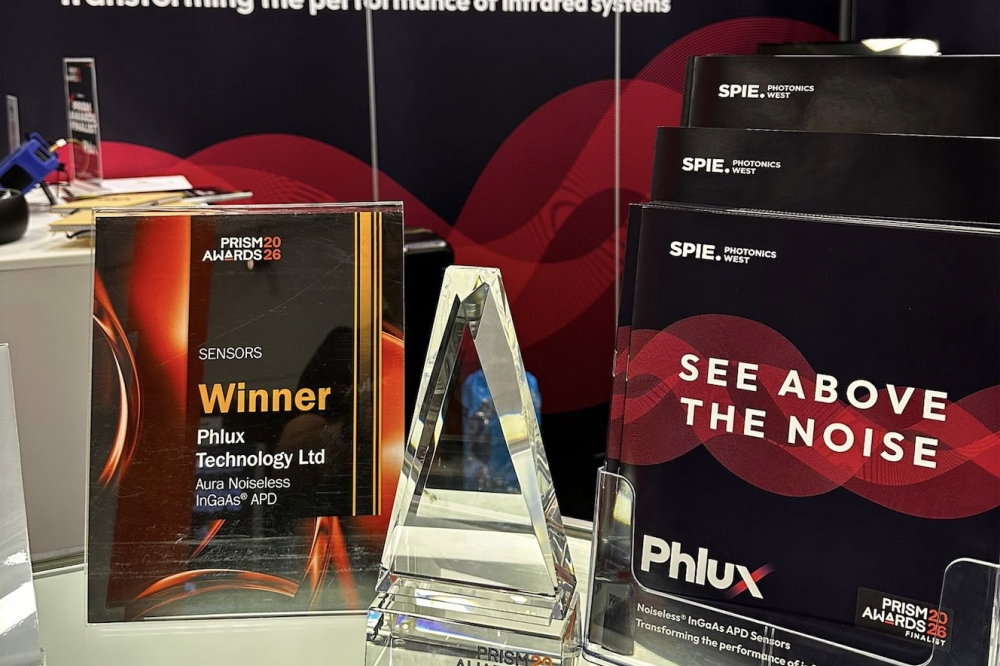
Phlux’s award-winning APDs feature an AlGaAsSb multiplication layer that delivers a step-change in sensitivity.
With compound semiconductor devices, there’s no doubt that the devil is in the detail. Incremental changes to just one layer can be a game-changer – shifting emission to hit the target wavelength, boosting mobility to record levels, or enabling countless electrons to leak away or the dislocation density rise to damaging levels.
When it comes to the avalanche photodiode (APDs), a device that dates back to the 1970s and has undergone minimal revision over most of that time, a hike in performance is now being realised by one start-up, UK-based Phlux, through a modification to the crucial multiplication layer. Out goes InP, and in its place a quaternary containing antimony.
That’s the only significant change to the APD, a class of detector deployed in optical communication networks, lidar systems, and optical test equipment. This device absorbs incoming photons in an InGaAs layer, with the resulting electron-holes pairs are then swept into a multiplication region, traditionally made from InP, where the electrical signal is amplified through a process known as impact ionisation.
As APDs are deployed in low-light applications, the signal must be amplified – but this comes at a price, with noise increased more than the signal in traditional devices.

The structure that produces an internal gain mechanism in an avalanche photodiode.
To address this issue, much effort has been devoted to developing a superior methodology for amplifying these very weak signals. Alternative approaches include the introduction of complex ‘staircase structures’ that manipulate the journey electrons take through the device. But this has delivered limited success.
That’s not the case for Phlux’s ground-breaking technology. This spin-out of the University of Sheffield, founded in 2020, is now grabbing headlines for impressive product specifications and a coveted industry award.
According to company CEO and co-founder, Ben White, critical to the success has been the search for new materials with properties ideal for multiplication.
He is a humble man, freely admitting that they stumbled on using antimony-based materials, specifically AlGaAsSb, a quaternary he describes as having really weird properties.
“The electrons within the conduction band can multiply quite readily, whereas the holes within the valence band are really heavy and very, very sluggish,” says White. What’s more, the holes struggle to get enough energy to reach the split-off band, where they would multiply.
Thanks to the introduction of AlGaAsSb in the multiplication region, Phlux’s APDs provide a sensitivity that’s an order-of-magnitude higher than the incumbent. This level of superiority ensures a higher signal-to-noise ratio and ultimately allows adopters of this device to produce products with better specifications, such as lidar with an increase range and test equipment with a lower noise floor.
A second chance
White has spent many years developing Phlux’s technology, initially investigating AlGaAsSb technology with the company’s other co-founders – the University of Sheffield academics Jo Shien Ng and Chee Hing Tan – when a PhD student between 2012 and 2016, and then following 18 months of travelling, working as a research associate.
Soon after his return to the lab, the team published a high-impact paper on the use of AlGaAsSb in APDs.
Previously, when Tan and co-workers realised similar academic success with a different material system, they patented their work and waited for a company to license and commercialise their exciting technology. But that never happened. It is this a painful experience that the team has learnt from, vowing to not to let another opportunity slip through their fingers.
This time the team would take control of its destiny. To White, that makes a lot of sense: “We know more about this technology than anybody, and we're really excited about it for what it can do for the world. We should be the ones that do this.”
At that pivotal time, White could afford to take the personal risk of pursuing this dream, and with the support of his two-cofounders, convinced the Sheffield University to back them with a small investment. The Royal Academy of Engineering also played its part, helping to assist the first steps to commercialisation by providing White with an Enterprise Fellowship. For the first two years, Phlux focused on technical milestones. Could the start-up build a working device? How would the dark current change with the introduction of antimony? What about reliability?
After tackling all these challenges, Phlux produced a product, netted its first sale, and then secured a number of commercial design wins.

Laser rangefinders provided early demand for Phlux’s high sensitivity avalanche photodiodes. The components deliver much-improved performance, including extended range.
Underpinning all this progress was the securing of substantial funding, a task that’s not been easy for III-V chipmakers, according to White.
In his experience, investors can be put off by deep-tech, and semiconductors in particular, due to lengthy design cycles. He says that a few years’ ago, start-ups focusing on software-as-a-service had far more appeal, although now there are concerns that the plans of these companies can be disrupted, unless they scale to a substantial level.
Very recently, interest in photonics has risen, due to the rise of AI and increased demand on data centres, which are switching from electrical to optical signals. “I think the awareness of photonics, and potential impact of it, is now much bigger than it's ever been before,” enthuses White.
It’s a state-of-affairs that did not exist in 2022, and White is grateful for the investors that understand the optoelectronics space, and provided £4 million that year to fund the development of the first product. This time last year Phlux raised another £9 million to scale the technology, and penetrate new markets.
As well as commercialising its technology, funding has enabled the expansion of the team, which has evolved from just those with technical expertise to those that offer other skills, such as operational experience, marketing and finance. Headcount is forecast to grow by another five or six this year, taking the team to around 30 staff.
Initially, Phlux drew on the expertise of the UK III-V National Facility, located within the heart of Sheffield, for the fabrication of its APD epiwafers. Today this supports R&D, but production is outsourced, with Phlux a fabless entity that has partners providing growth, processing and packaging.
However, at the start-up’s headquarters, which occupies around 3,500 ft2, there’s more than desks and computers. There’s also a cleanroom and an engineering lab, used for what’s described as ‘look-ahead testing.’
“When you do the full range of reliability testing, you need some very specialised equipment,” explains White. While Phlux does not have that capability, it is able to gauge how a batch of devices is performing, as well as investigating variations in characteristics and undertaking quality assurance.

Phlux Technology has invested in in-house facilities for APD performance testing and quality assurance.
The facility is also used to produce products that combine an APD with a low-noise amplifier, which is critical to getting the best performance from this detector.
As it’s a challenge to grow epitaxial structures with quaternary layers, this is a key element of Phlux’s IP. “But just as much IP is now in the fabrication as in the growth,” says White, who points out that it’s far from easy to progress from making one working APD to millions of them.
Multiple markets
As Phlux’ founding coincided with what White describes as a peak-hype cycle for autonomous vehicles, the company initially pursued the lidar market. But when that promise failed to fully materialise, and competition for short-range applications intensified, they adopted the traditional approach for a start-up, focusing on high-value, lower-volume applications. They are related to defence, sensing, test equipment, and next-generation lidar.
Today, White views the communication industry as the biggest potential market, but also sees a great, longer-term opportunity in robotics, due to the high level of integration required to build products.
Crucial to success is raising the profile of the company, an objective that will be helped by the winning of a Prism Award, which White refers to as the Grammys for the photonics industry.
“We genuinely did not expect to win up against companies like ams Osram. But it was an amazing reflection on the success of the team over the last few years, and the great opportunity that we have for us at Phlux.”