
Tiny LED design could shrink next-gen systems
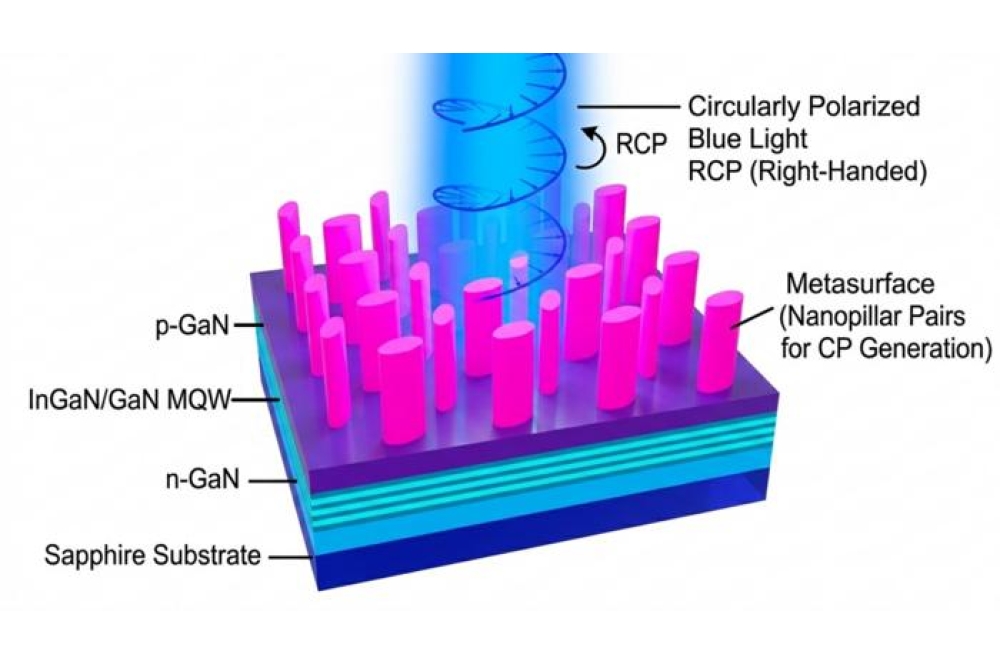
In an article published in Optics Letters, researchers from The University of Osaka announced a new LED design that may help shrink complex optical systems into much smaller devices. The LED produces circularly polarised light using a built-in nanostructured surface, eliminating the need for bulky external optical components.
Circularly polarised light, whose electric field rotates like a corkscrew as it travels, is essential for technologies such as 3D displays, advanced imaging systems, and quantum communication tools. Traditionally, generating this kind of light requires optical components such as polarisers and special plates that modify the light’s phase. However, these components make devices larger, more complex, and harder to integrate.
“Our goal is to simplify the way circularly polarised light is produced,” says corresponding author Shuhei Ichikawa. “By integrating polarisation control directly into the LED with a specially designed metasurface, we remove the need for additional optical components.”
This metasurface consists of extremely small GaN nanopillars directly arranged in a carefully designed pattern on the surface of a semiconductor LED. The nanoscale structures manipulate the phase of light so that one circular polarisation state is selectively transmitted while the opposite polarisation is suppressed.
“Computer simulations show that the design can produce strong circularly polarised light while allowing about 35 percent of the LED’s light to pass through the nanostructured surface,” explains Shuhei Ichikawa, senior author. “That level of efficiency approaches the theoretical maximum of 50 percent.”
Unlike many previous circularly polarised LEDs, which utilise organic materials or complex spin-based systems, the new design uses robust inorganic materials, which could help enable more durable and practical circularly polarised light sources.
“Theoretically, there is a tradeoff between LED efficiency and polarisation degree, which measures the extent to which one polarisation state dominates,” says Ichikawa. “What is very exciting about this device is that we have found a way to maintain high levels of both.”
In the future, such compact circularly polarised light sources could simplify the optical hardware used in virtual reality headsets, high-resolution 3D displays, and emerging photonic technologies. Thanks to the team’s research, the future of smaller and more efficient light-based devices is definitely looking bright.